
We’ve been to Switzerland many times before, but there is always more to see and do. The idea behind this trip in June 2023 was to visit some areas of Switzerland we had never visit and to revisit others where we had only been when leading a tour group.


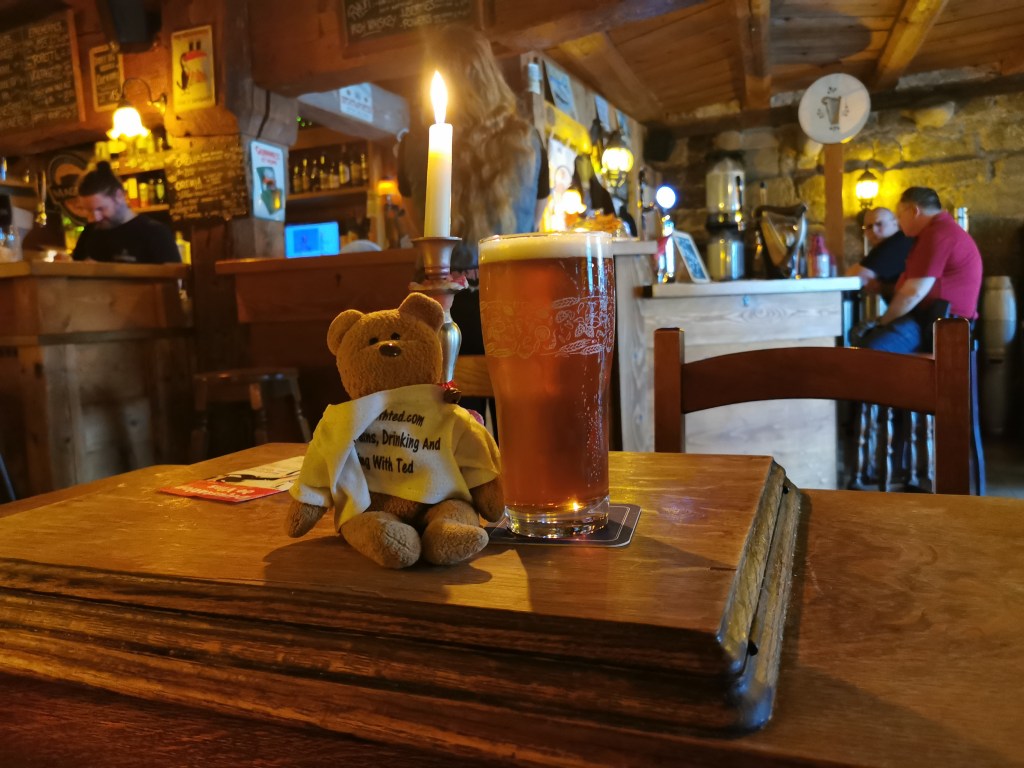
It didn’t start well. Ted and I were asleep in a Travelodge in Edinburgh when we were woken at 0300 by a message on my phone, informing us that our 1100 flight to Geneva had been cancelled. Somehow I managed while half-asleep to rebook on a flight that evening and sort out a hotel at Geneva airport. The day was spent hanging around Edinburgh – the highlight of the day was eating haggis, neeps and tatties in the Abbotsford Bar (pictured). The evening flight was late and we reached Geneva in time to catch the final shuttle bus of the day to the hotel at 2330.
Onward to Fribourg
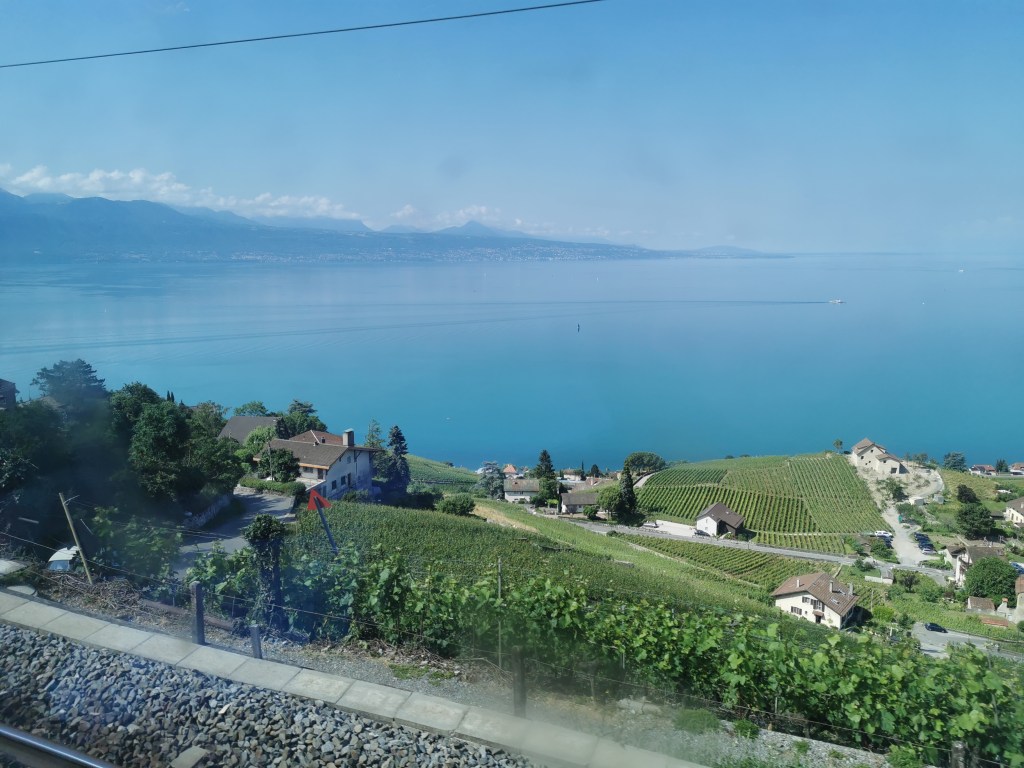
On Sunday morning we set off for our intended first destination, the city of Fribourg. The sixteen carriage double-deck train from Geneva Airport provided a good view during the journey. We called at Geneva, travelled along the lakeside to Lausanne, then uphill at impressive speed looking over the Lavaux vineyards (pictured) and into the Canton of Fribourg. We could see the Alps in the distance as we passed through typical Swiss scenery – villages surrounded by small fields with cows (with bells) grazing. After 1 hour 45 minutes we arrived at our destination.

Yverdon-les- Bains
Had things gone according to plan, we would have spent the day travelling to and around the Jura mountains. Time didn’t permit so we decided instead to take a short trip to Yverdon-les-Bains on the Lac de Neuchâtel, through a series of small villages served by a half- hourly train service. Had this been the UK the line would most likely have been closed many years ago.
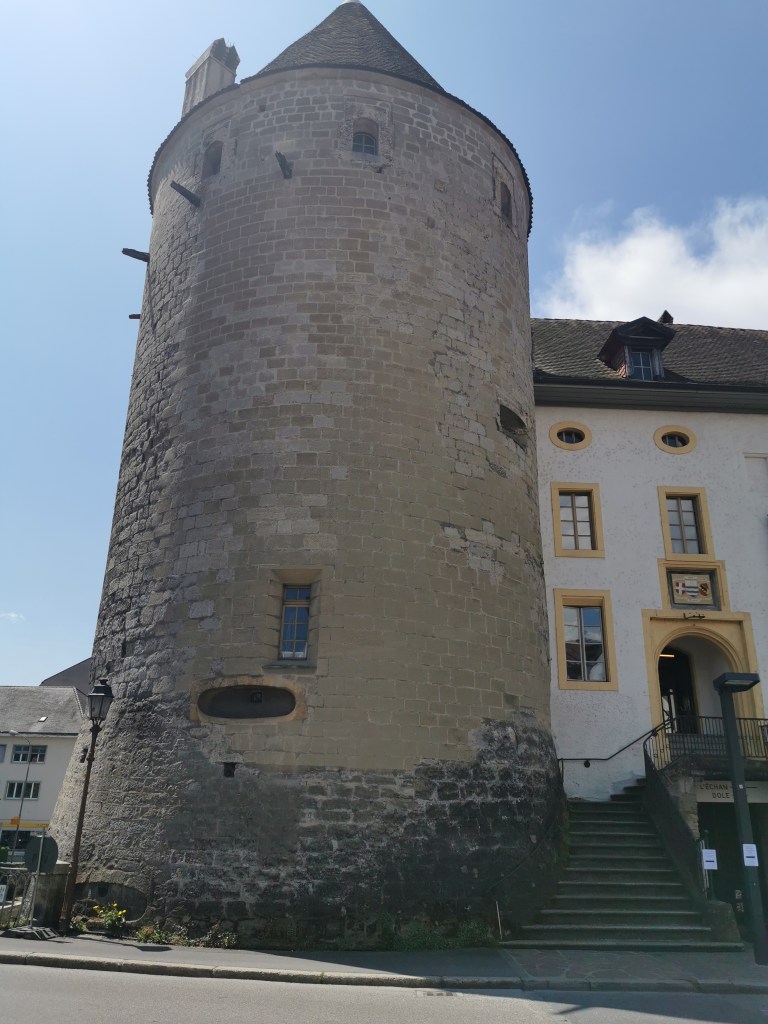

We knew nothing about Yverdon and it turned out to be a pleasant small spa town. Down a street off one corner of the station square and you are in the centre of the old town. There’s a turreted castle, a market square and, more importantly, several café-bars.

We chose Le Bar du Coq, which was a good choice, as there we discovered that the range of beers in Switzerland has improved in recent years. After our lunch break we returned to Fribourg and caught a taxi to the hotel. We reached it just before reception closed at 1500 on a Sunday – our information was that we could check-in from 1500, but that was if we had arrived on Saturday as planned.
Fribourg
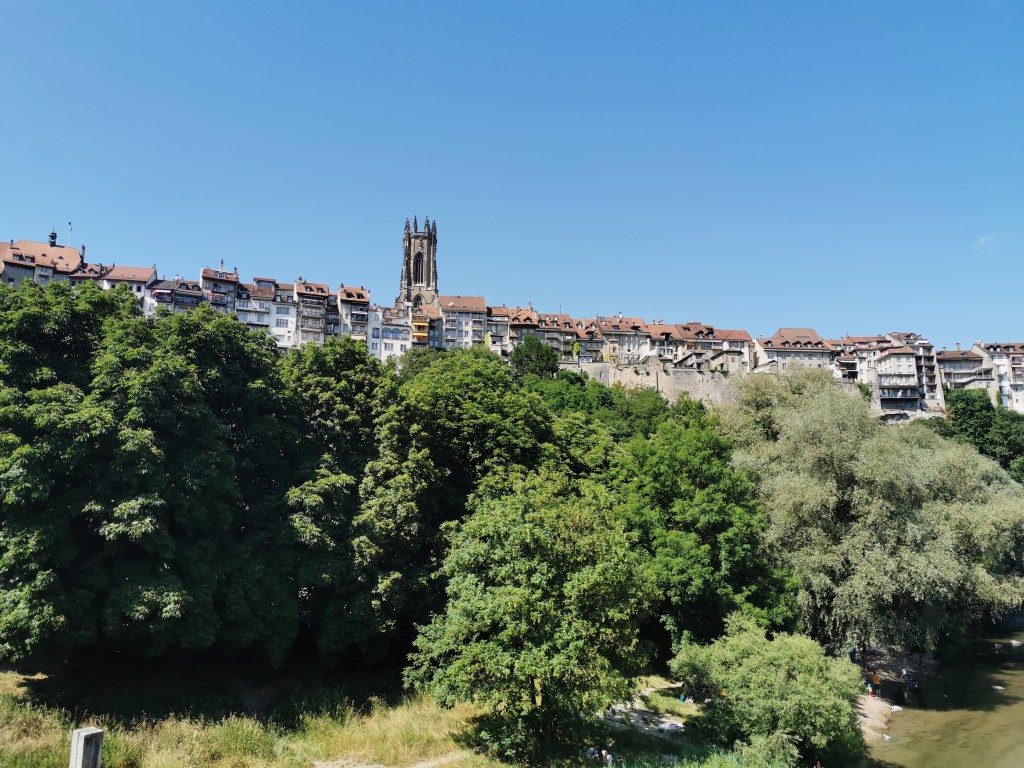
Fribourg is a small university city with a population of about 40,000. It is situated on a loop of the steep-sided River Sarine and reminds me of Durham. It is astride the linguistic divide between French and German speaking Switzerland – it is also known as Freiburg and the river as the Saane. The modern city, by the railway station, is above the valley, from where the Rue de Lausanne leads to the Bourg – the older city and the cathedral, on the hilltop peninsula. From there, streets tumble down the hill to the Basse Ville and the historic districts by the river – Auge and Neuveville.


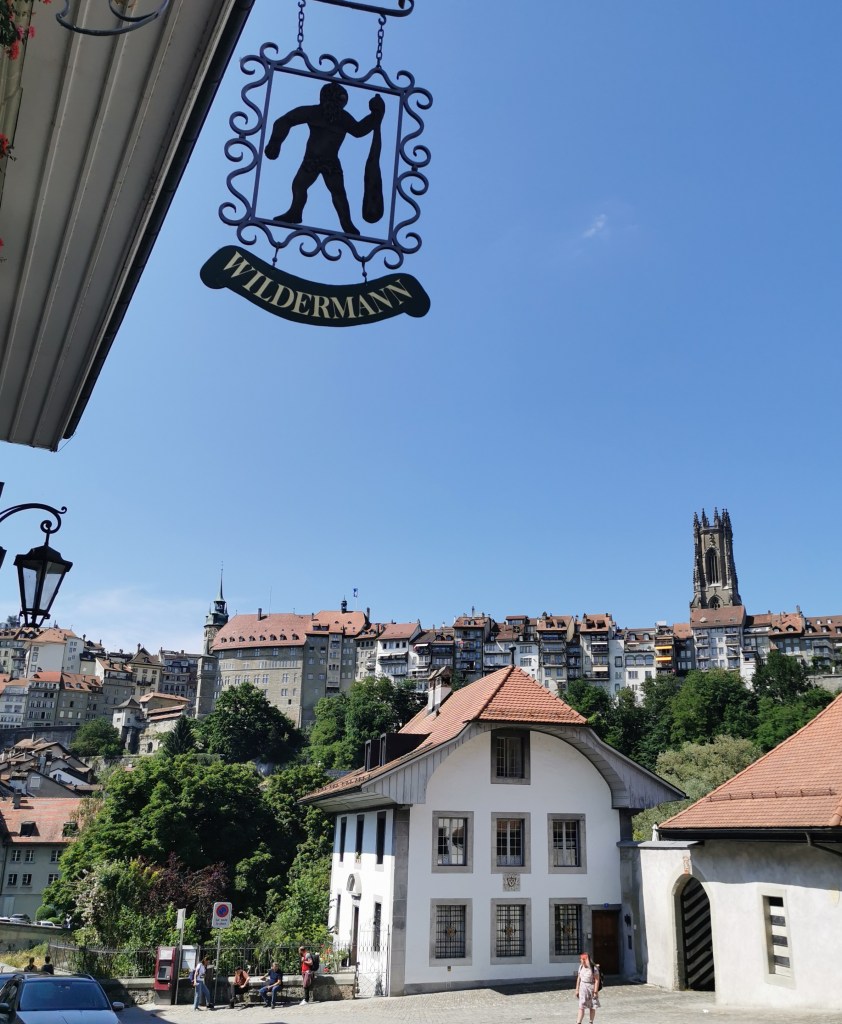
Along the river people were sunbathing and swimming and we caught sight of a huge lido. From Auge a bus climbs the hill to the railway station. There is also a funicular – we didn’t have time to try it, though it is reputedly the smelliest ride in Switzerland – it is water powered, the water coming from the sewers. The Basse Ville is largely traffic free and our excellent hotel, le Sauvage, was situated in the area.
The view from the hotel

After checking-in we caught the electric bus back to the station, picked up some odds and ends to eat, and began our exploration.
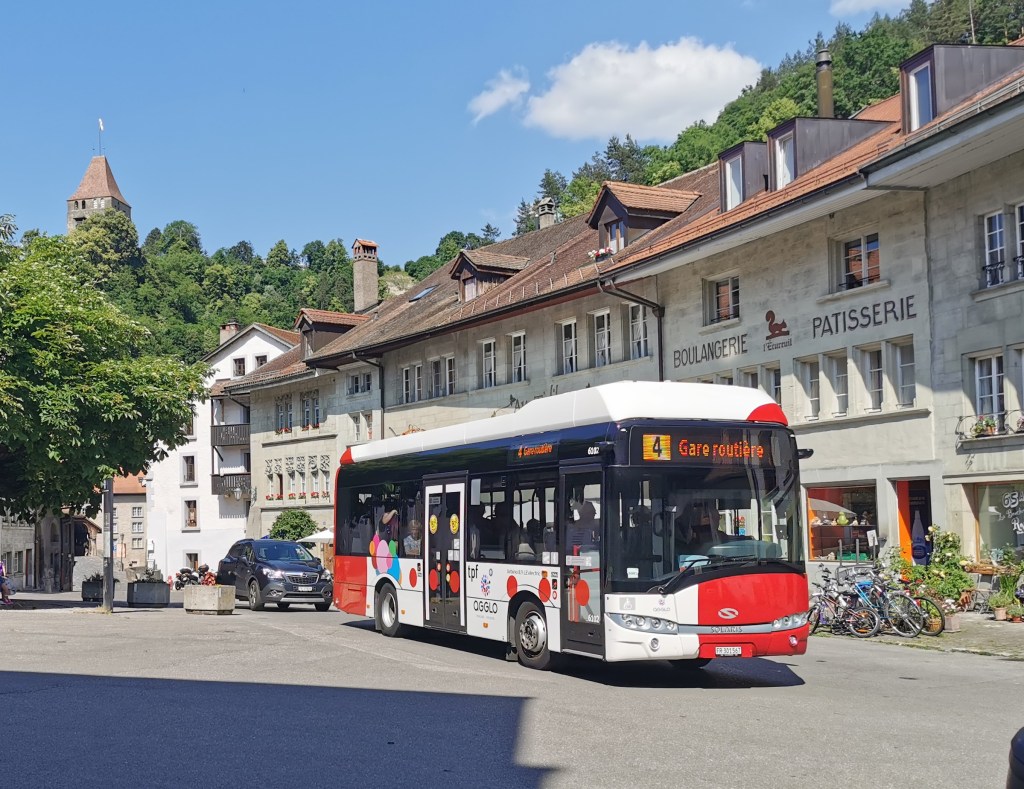
On a Sunday afternoon and evening places were busy with plenty of atmosphere. We found Les Trentenaires, reputedly the best place in town for craft beers. They were the most expensive beers we drank in Switzerland, but it was friendly and the beers were excellent. We wandered along to the Bourg and the cathedral then began the descent back down to Auge.


The Bourg, leading to the cathedral
Part-way down is Café Belvédère with decent beer and tremendous views over the river valley from the terrace and beer garden (pictured). The barman was friendly, the playlist was to our taste and, when he realised I was from Scotland, he invited me to choose a Scottish song.

It had to be he Proclaimers’ 500 miles. I told him the meaning of ‘haver’ and he told ne the story of being in Manchester, where he lost his phone, was ‘abducted’ by a group of Scots lads, then spent a very drunken week with them in Edinburgh. Down the stepped street we finished up at the Banshees’ Lodge in Auge, with more fine beer.
We liked Fribourg a lot and it is great pity that we only had one night there rather than the two we had planned – maybe we’ll be able to return.
Fribourg to Mürren
Our next destination was Mürren, a resort in the Bernese Oberland. In order to see some new territory we didn’t travel by the most direct route. The first train of the day took us from Fribourg to Bulle, where there was a connection with the narrow gauge railway to Montbovon (see note 1). Bulle looked attractive but we only had enough time to take a photo of the town with the mountains in the distance.

En route to Montbovon the train called at Gruyères where most passengers alighted – probably to visit the cheese factory and its electronic cow Cerise. It is a picturesque village and worth a stop (see note 2). The train then pootled alongside the road and enters Montbovon along a street.
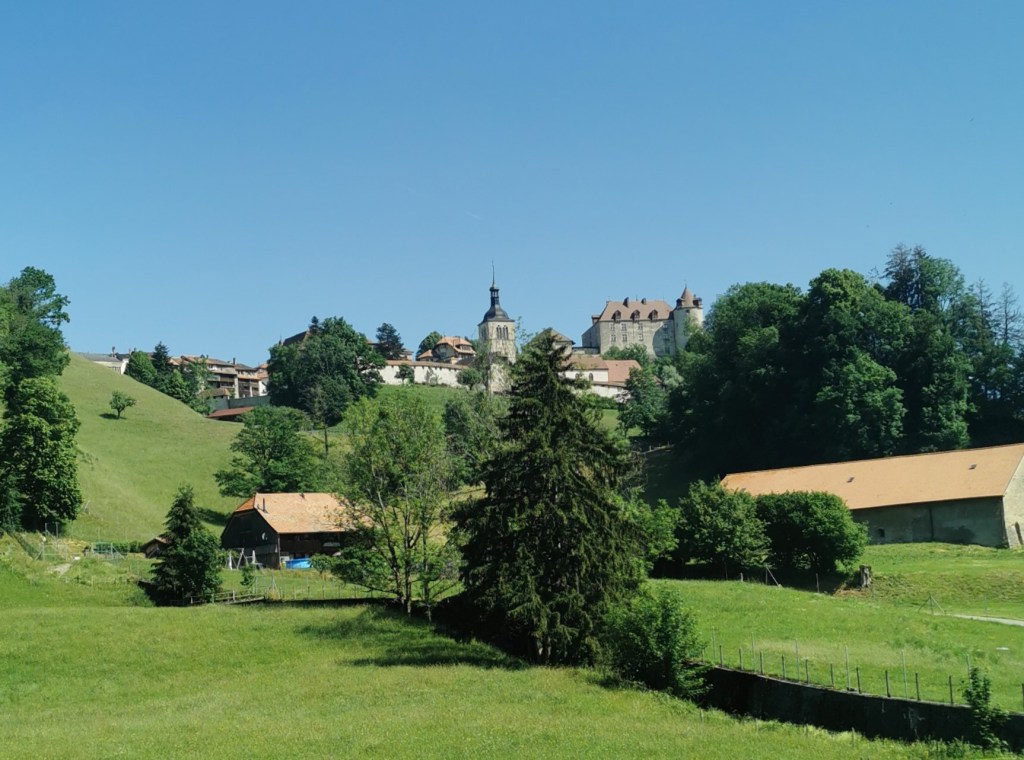
We changed to the Golden Pass line, which runs from Montreux to Interlaken. The stretch from Gstaad via Zweisimmen to Spiez was new to us and lived up to its reputation as a highly scenic route. We sat in a panoramic carriage, where a youngish lad nearby was carrying an alpenhorn. The line climbs by taking a long loop around Gstaad, avoiding the need for a rack and pinion section, then climbs to 1270m over the Saanenmöser Pass, with spectacular views across to snow covered mountains and, finally, down to Zweisimmen where we changed trains from narrow to standard gauge. Golden Pass Expresses can travel through, using a gauge changer. The line then follows the Simmental valley to Spiez on Lake Thun.
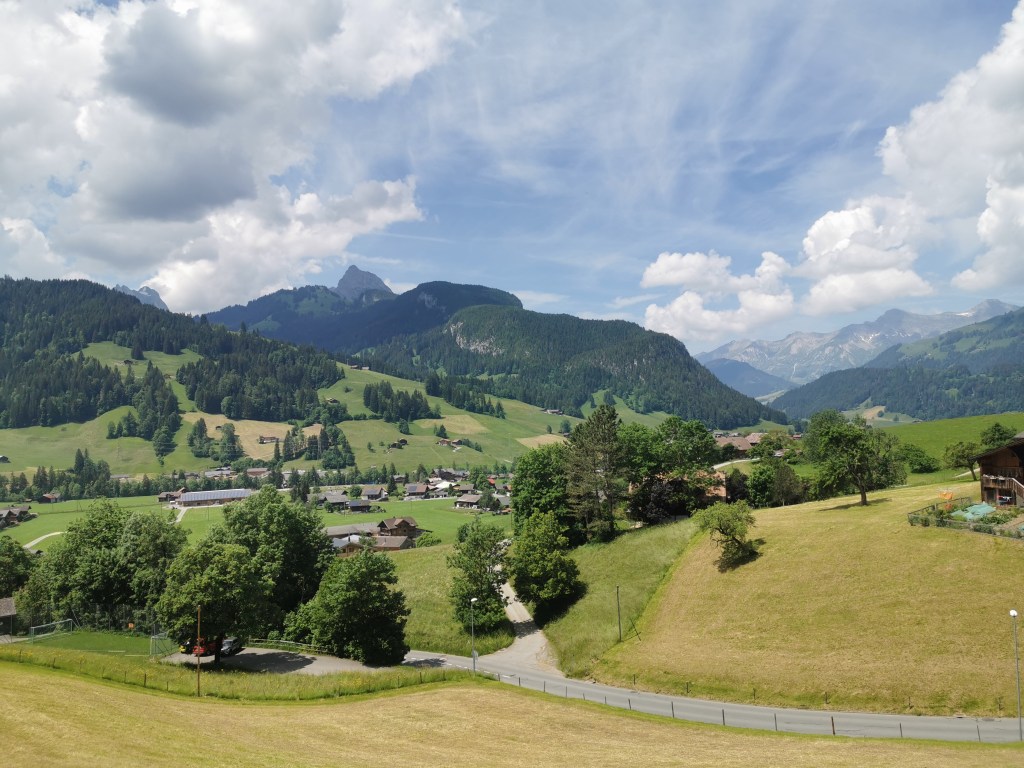
Two views from the train between Gstaad and Zweisimmen
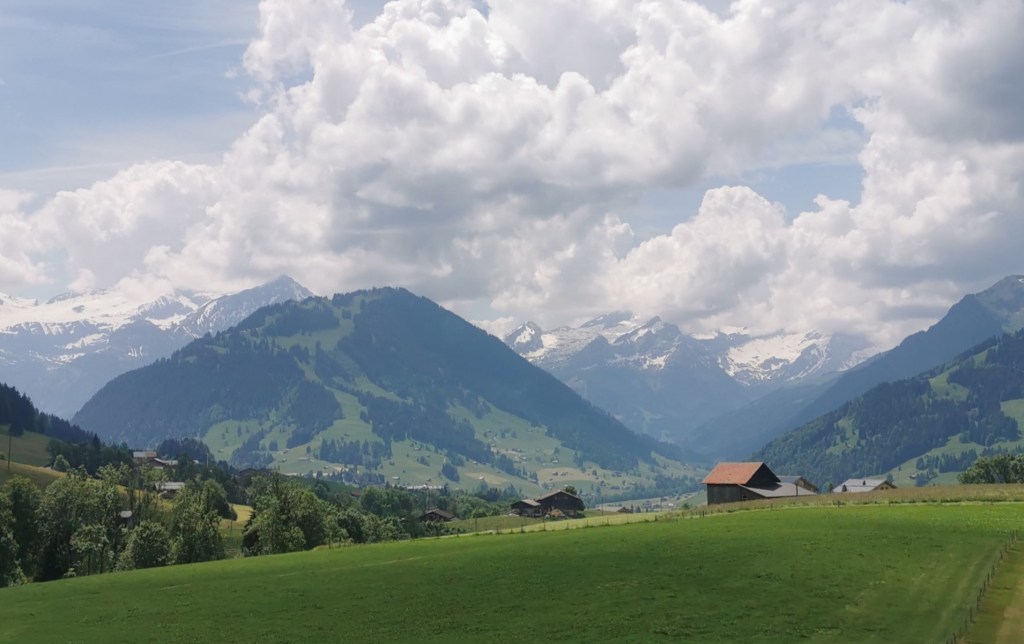
From Spiez we travelled to Interlaken Ost and onwards to Mürren by narrow gauge train to Lauterbrunnen, cable car to Grütschalp and railcar along the ridge to Mürren. These lines, and the other railways in the Bernese Oberland are covered in the Bernese Oberland section of the Switzerland by Rail page – Switzerland by Rail).


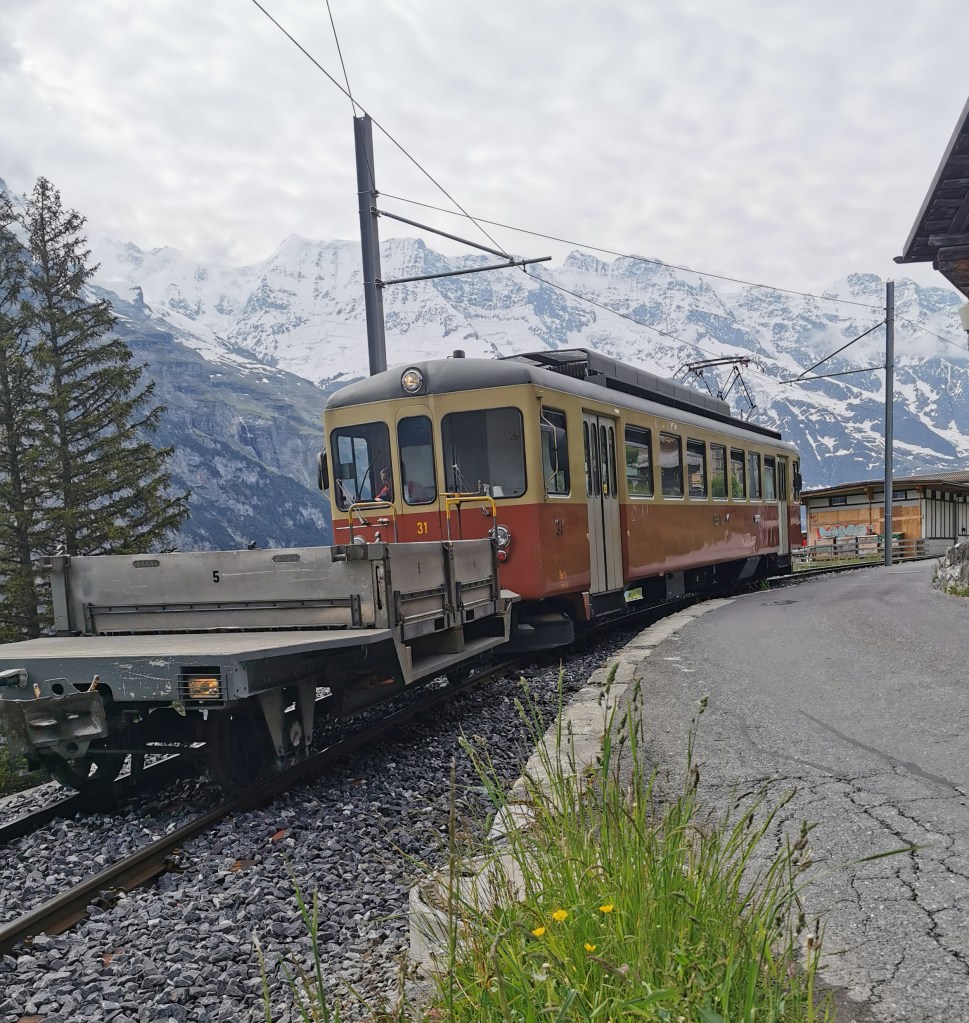

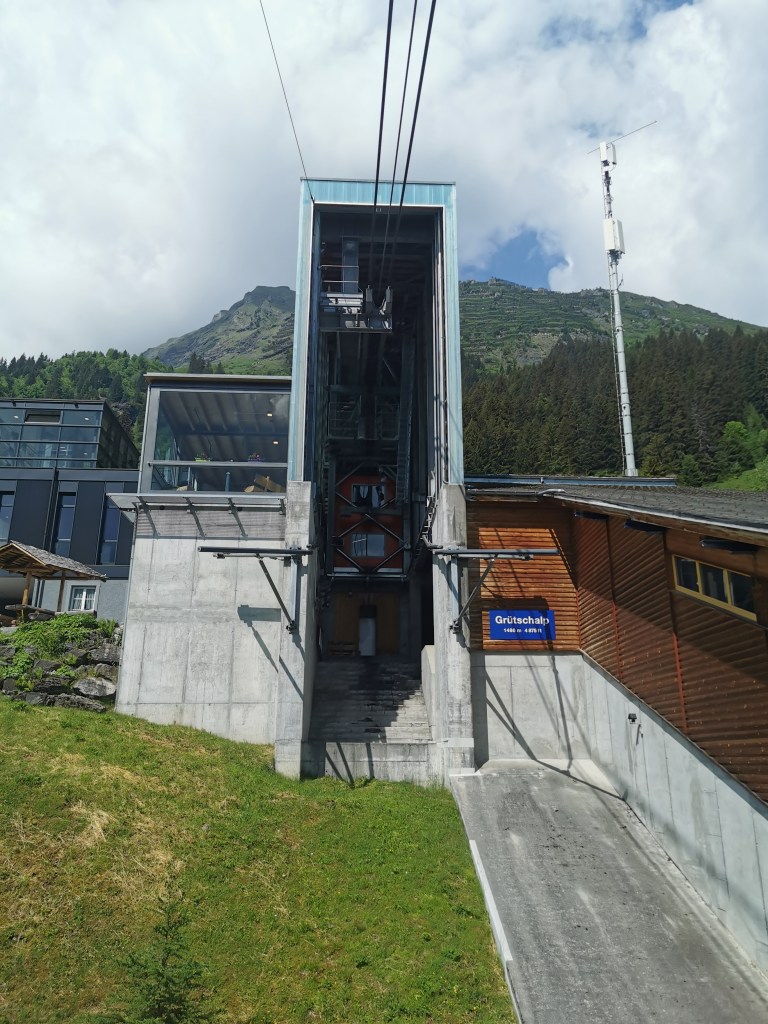
Views of the cable car and railcar between Lauterbrunnen and Murren. They show how goods are transported to the village and the former line of the funicular, which was replaced by the cable car. New railcars have been delivered and the final day of operation of the old railcars was 20 October 2024.
Mürren
I’ve been to Mürren and the neighbouring area of the Bernese Oberland several times before with tour groups but I’ve never stayed overnight in the village – this was a chance to look around and relax without forty people in tow. Mürren is an out-and-out tourist destination – it has a small resident population of 417, plus 1495 guest beds (note 3).

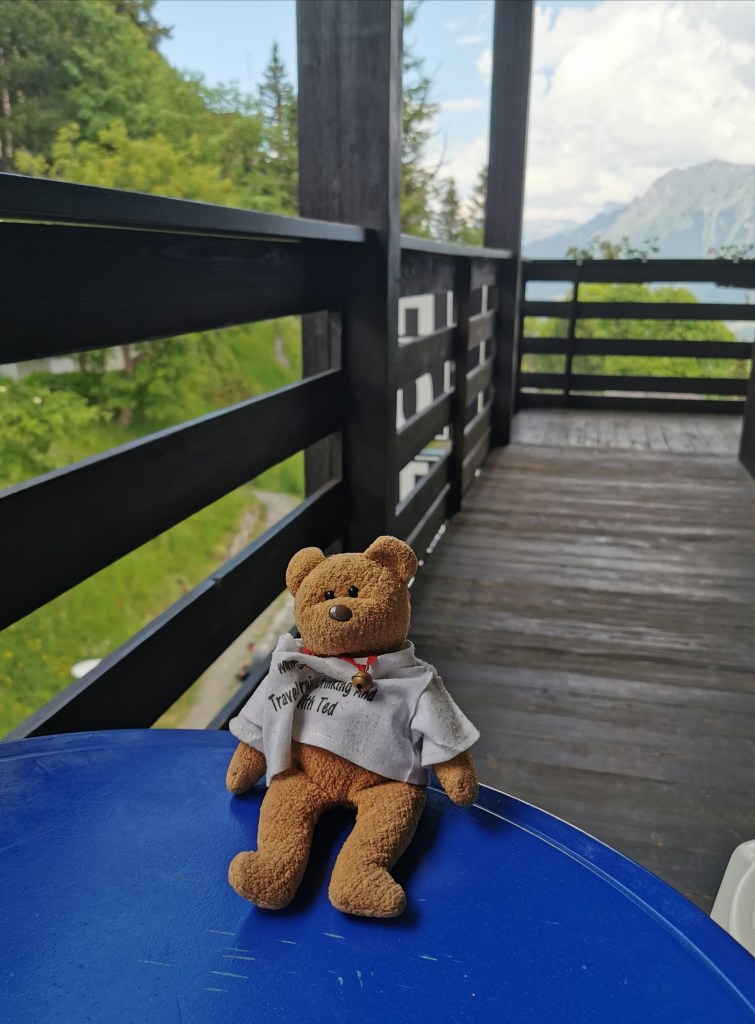
The view from nearby Murren station (forgot to tuck in the beergut again) and Ted on the hotel balcony
The only access to Murren is by cable car and it is a peaceful traffic-free resort. There are a few vehicles around – they are required for deliveries, building work and waste disposal. The snow free period in summer is peak season for building work. Much of the work is carried out by helicopter – it feels quite odd to look down from Mürren and watch helicopters flying below in the Lauterbrunnen valley.

We checked in to the Hotel Alpina. It was the least expensive of the trip and our basic room was on the third floor with no lift, but we had no complaints. The location is superb, there are tremendous views from the public areas and room balconies, the staff were friendly and the breakfasts were good.
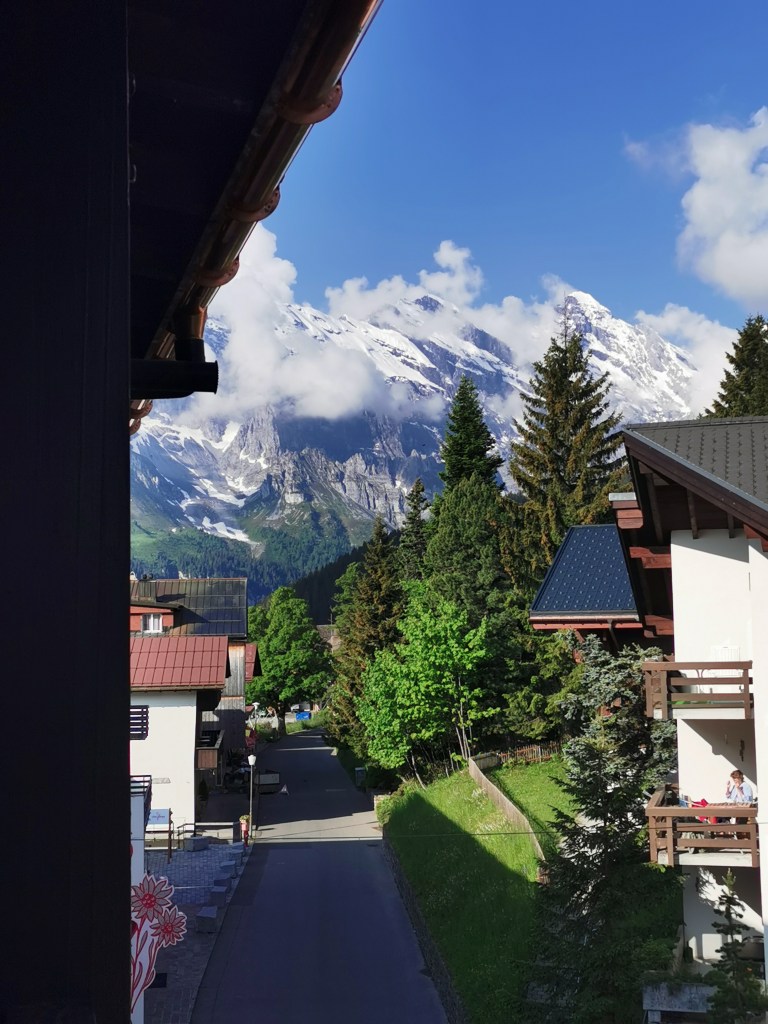
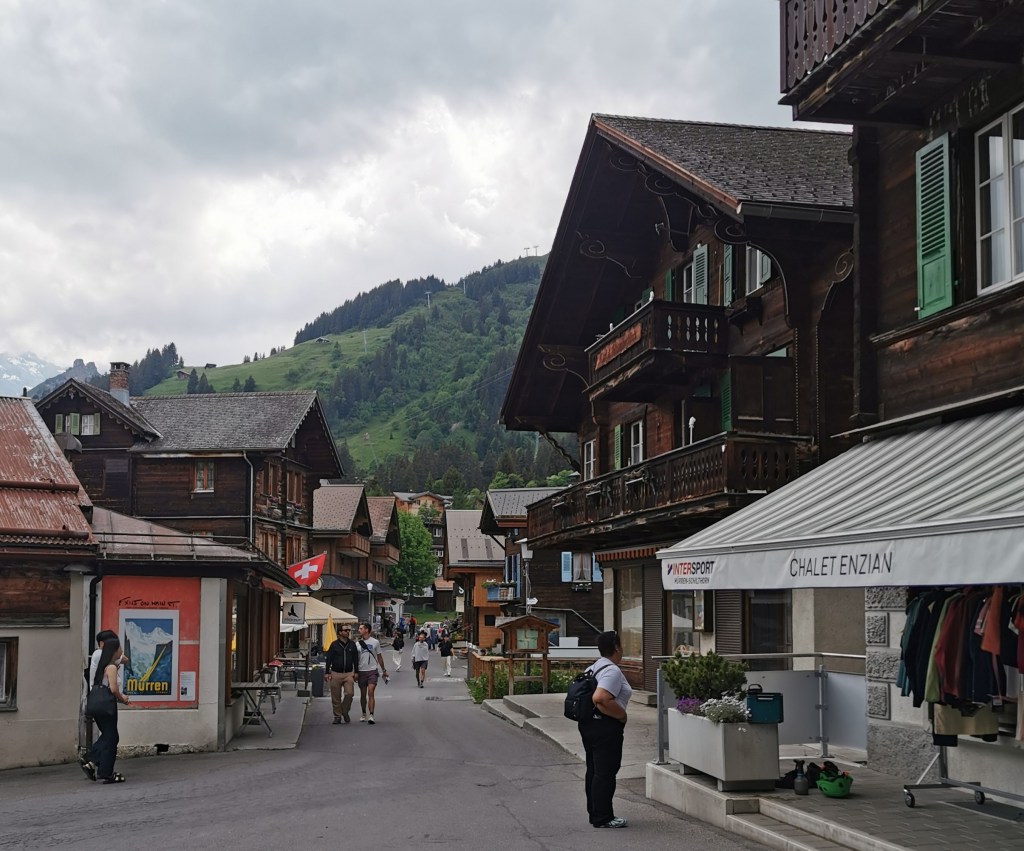
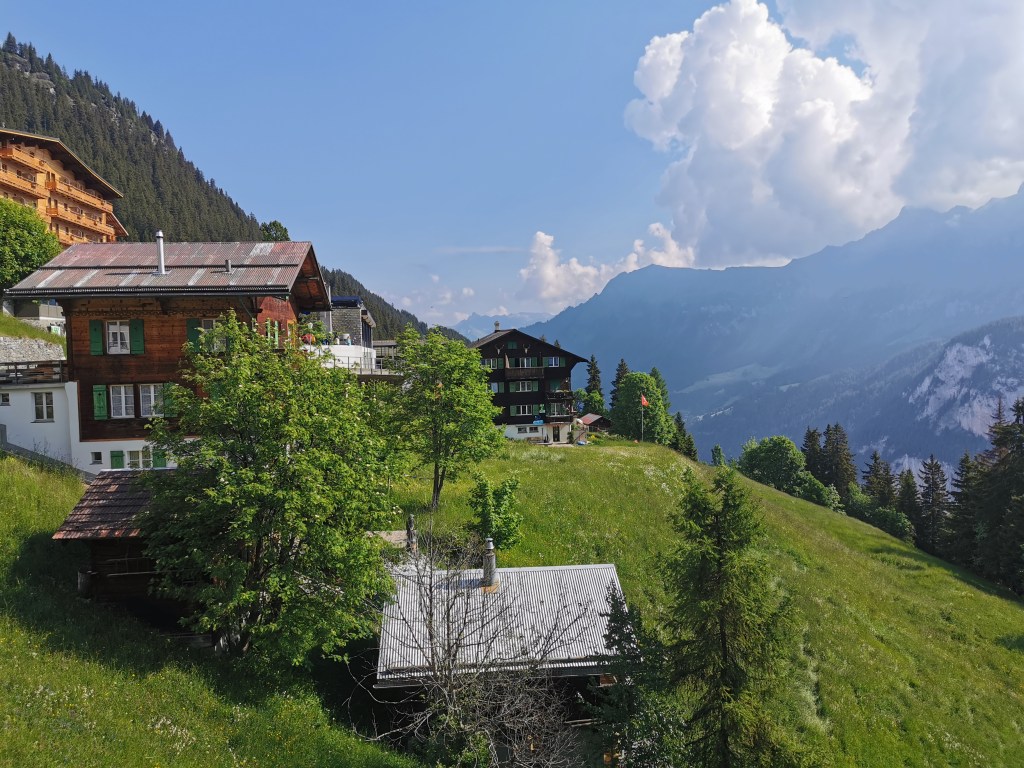
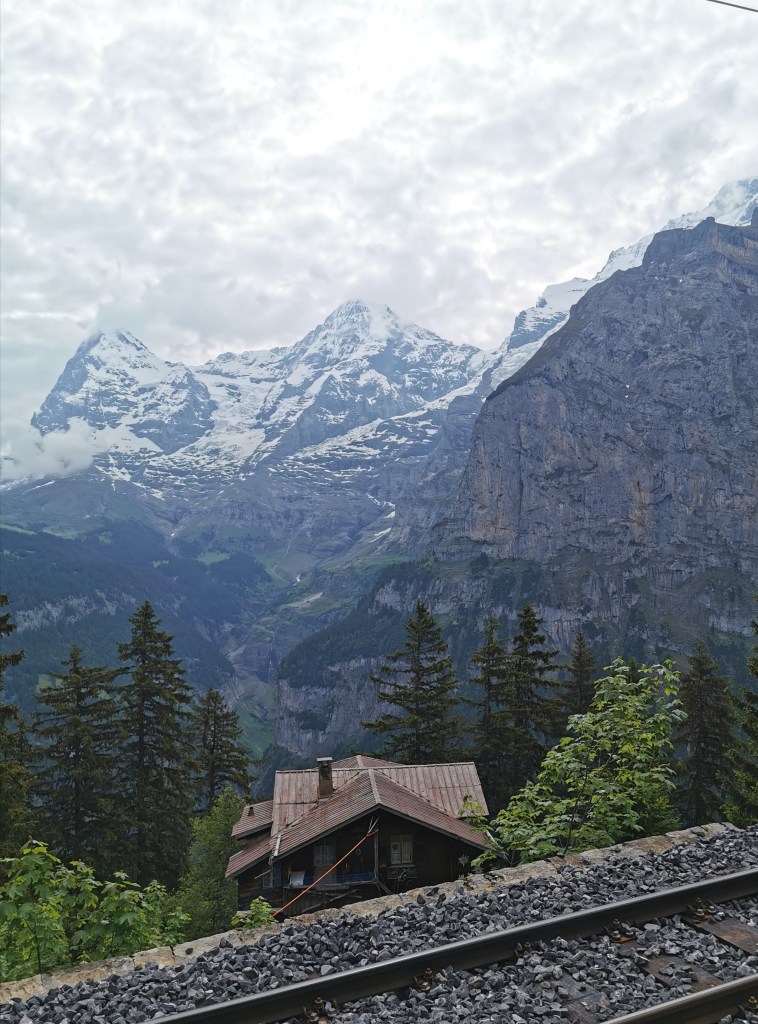
Mürren looks over to the Eiger, Monch and Jungfrau mountains, down to the Lauterbrunnen valley and across to Wengen. There was cloud on the mountaintops during most of this visit. There are plenty of places to eat and drink (mainly in hotels) and a well-stocked Co-op for supplies. We liked the bar in the Eiger Guesthouse, by the railway station, which has decent beer and a pub atmosphere.
Eiger Express
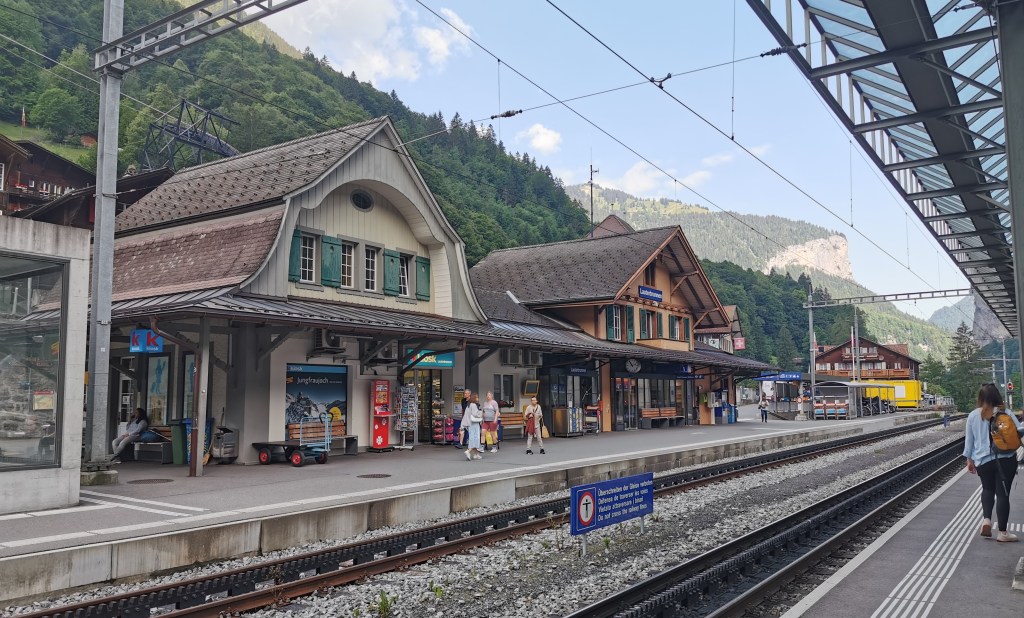
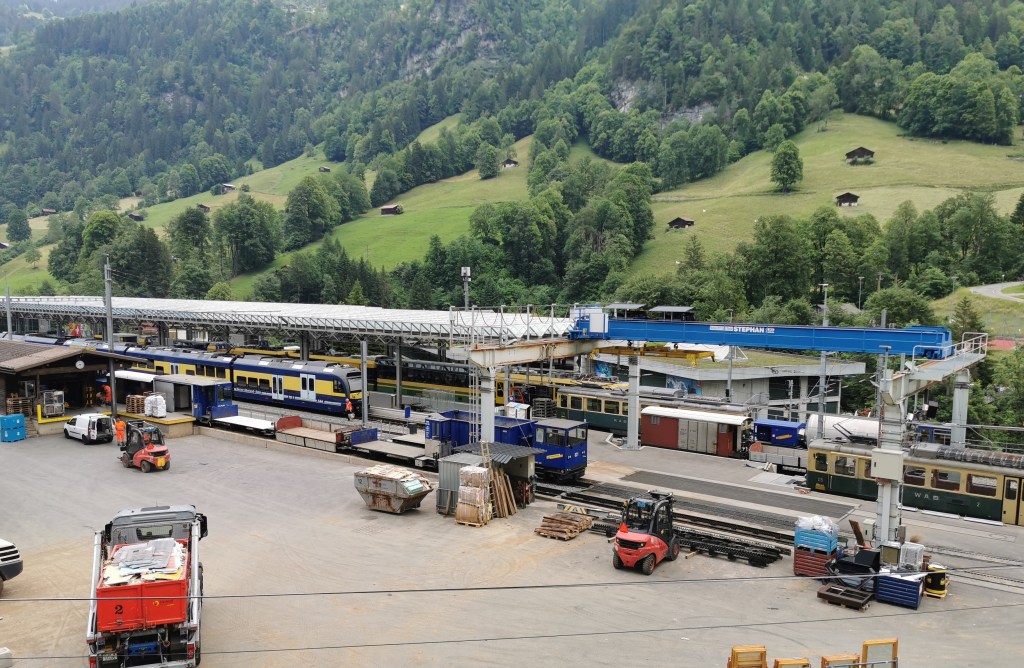
The plan was to revisit a few of the local railways and travel on the Eiger Express – a new cable car constructed since my last visit to the area. Ted and I headed back down to Lauterbrunnen to start the day. We had to reverse the planned route of the journey due to the temporary closure of the Lauterbrunnen – Interlaken railway. Our first stop was Wengen, with views along the way across the valley to Mürren. There we sorted out a ticket for the next section and took the opportunity to have an early beer in the Crystal Bar pub.

From there we travelled to Kleine Scheidegg, the junction for the railway to Jungfraujoch, the highest station in Europe and the most expensive to reach. We’ve been up there before – it is worth it as a once-in-a-lifetime experience. It had been threatening to rain and we had just settled on the terrace of the station restaurant with beer and bratwurst when it began to rain heavily. We moved to shelter – fortunately it was only a short shower.


Next was a short journey on the Jungfrau railway as far Eigergletcher, the top station of the Eiger Express. Eigergletcher station has been rebuilt for the cable car and is a concrete monstrosity – but it is worth a look outside if you can find the exit.
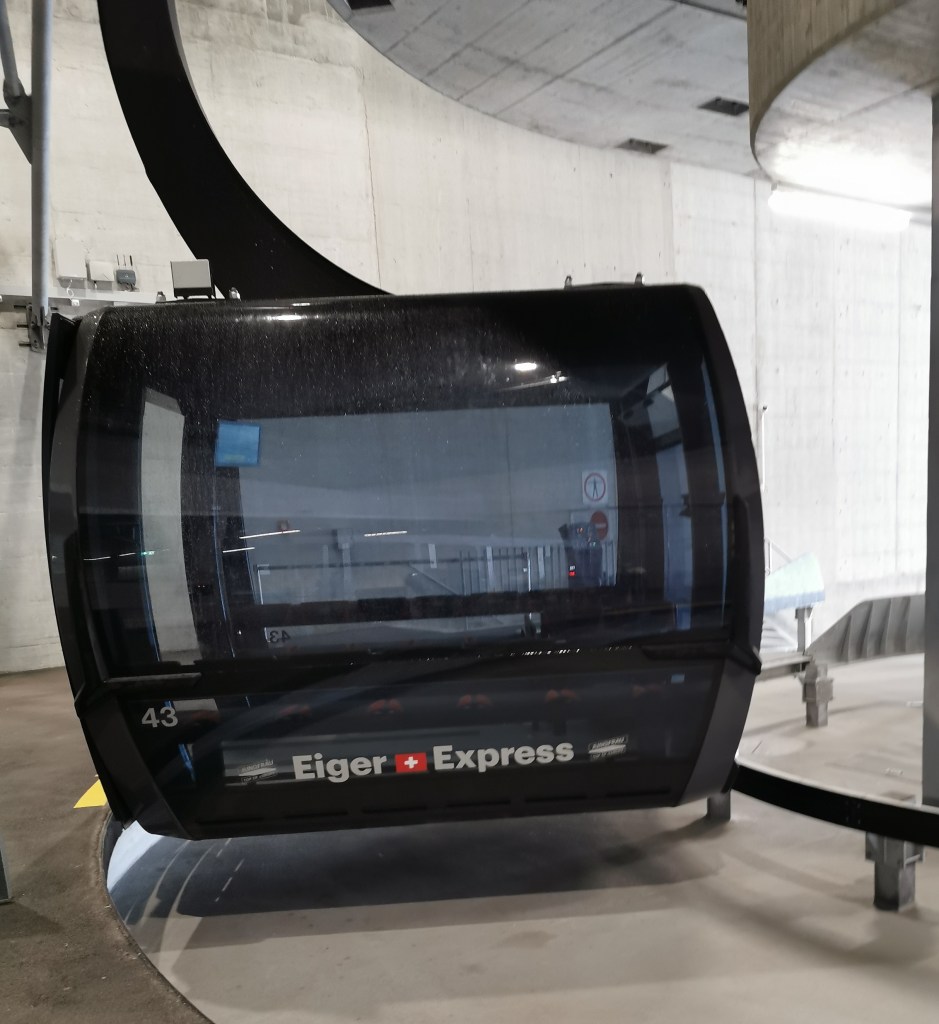

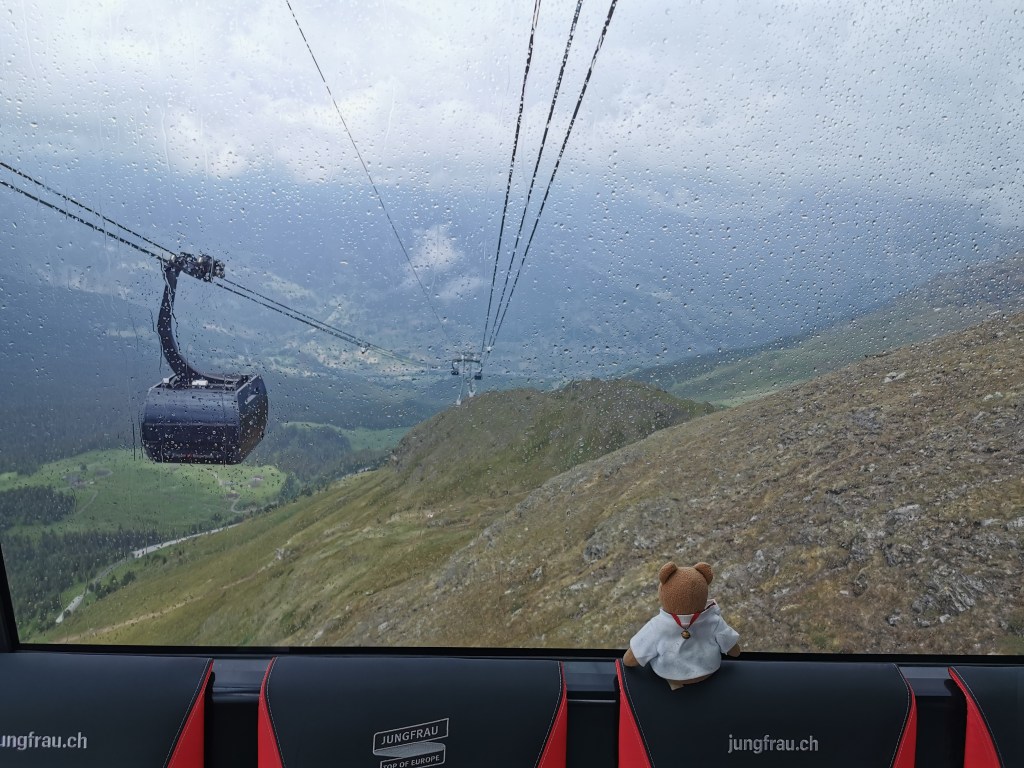
The Eiger Express was built to link Grindelwald and Eigergletcher, relieve overcrowding on the trains and speed up the journey to Jungfraujoch. The cabins take 26 people – the weather had reduced numbers that day and Ted and I were the sole occupants, and we thoroughly enjoyed plummeting downhill to Grindelwald, despite another shower (note 4).
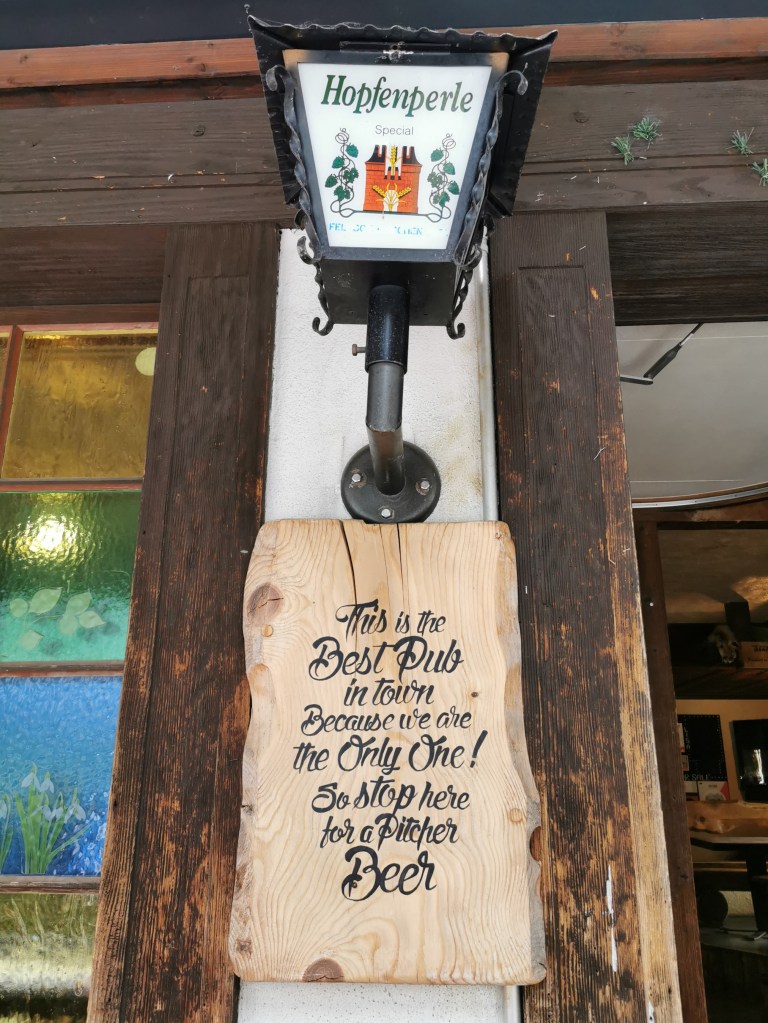
Grindelwald Terminal is a new station (and shopping centre) outside the village, where we caught the train to Zweilütschinen, then changed for Lauterbrunnen – the railway line had reopened. We sought out the only pub in town, the Horner Bar at the other end of the village. It was friendly, the beer was good, so we stayed there longer than planned before heading back to Mürren, where we had a final beer on our hotel terrace, finished just in time to avoid another shower.

Mürren to Andermatt

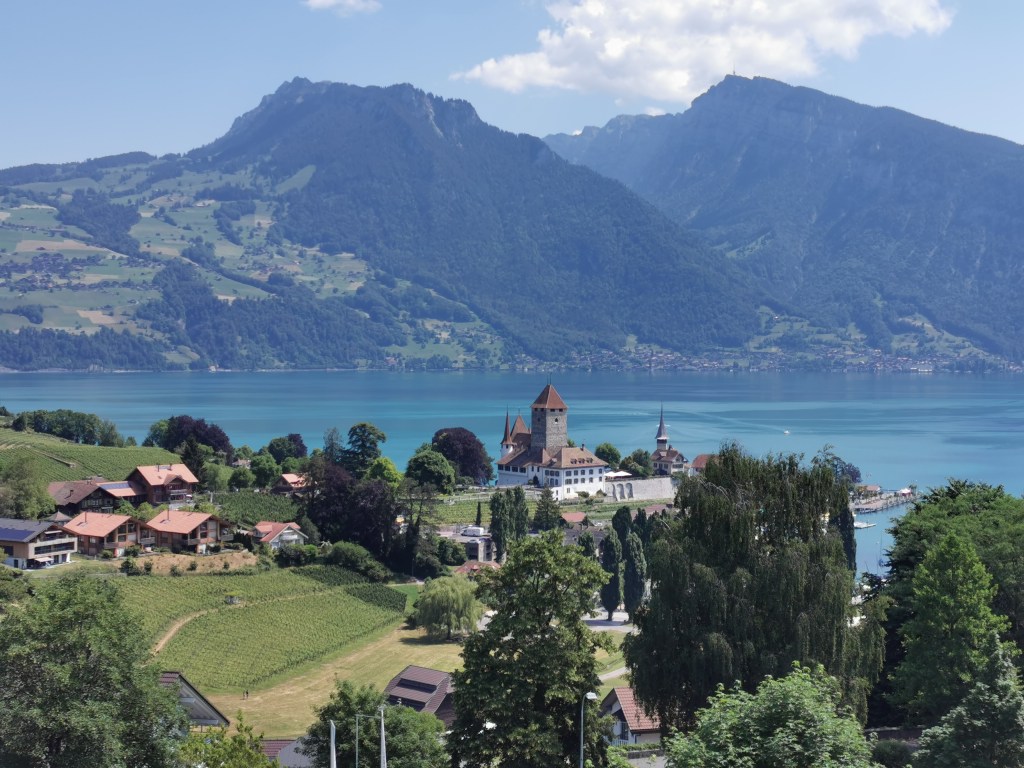
Our next destination was Andermatt. There is no direct route to get there by train (though there are proposals for a narrow gauge tunnel which will create a more direct link – see note 5), so we went the long way round. First we returned to Spiez via Grütschalp, Lauterbrunnen and Interlaken Ost. After a short break overlooking the lake we caught a fast train to Visp via the Lötschberg Base Tunnel to Visp and a break for lunch

Two of the remote villages along the route from Visp to Andermatt

From Visp we followed the route of the Glacier Express through Brig, Fiesch, Oberwald and the Furka Tunnel. We’ve travelled on the Glacier Express many times but this time we travelled on the stopping train. We were lucky to sit in a panoramic car at no extra cost. The Express is purely for tourists but the passengers on this train were locals travelling for a few stations, the occasional tourist, and school parties on end of term trips. There’s more about this route and the towns and railways of the area in the Glacier Express section of Switzerland by Rail.

Andermatt


I’ve passed through often, but never stopped in Andermatt before. The small town was in a key location at the foot of the St. Gotthard Pass, guarding the north-south route through the Alps, now bypassed by road and rail tunnels. It is at the crossroads with the east-west route from Chur to Brig via the Oberalp and Furka passes. It was a major garrison town (and remains a military training base) and is now being developed into a resort.

We settled into the Schlüssel hotel (pictured) – a friendly place with pleasant rooms with balcony views.
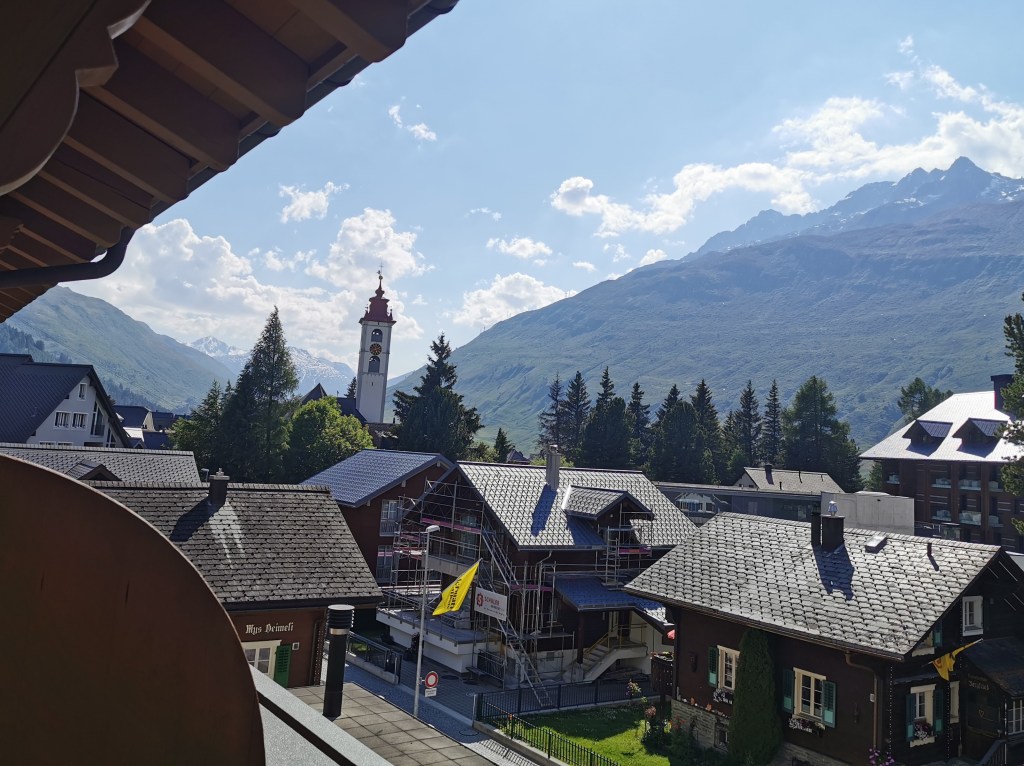
Two views from our balcony

It was also good value by Swiss standards – unlike Mürren and the Bernese Oberland, Andermatt is not on the standard tour of Switzerland, and our visit was during the low season between the winter sports and high summer seasons.

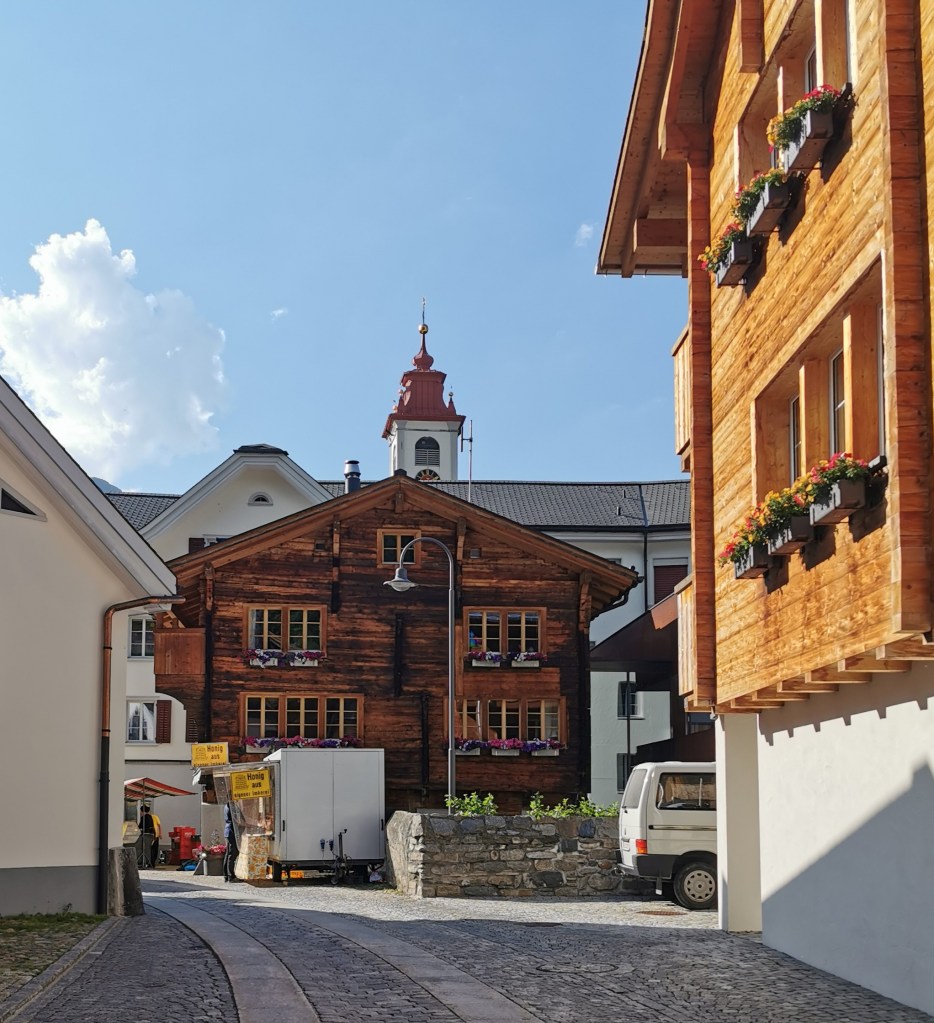
We set out to explore the town, wandering around the attractive old centre. Switzerland still has military service and there were plenty of young people around in camouflage gear having a (civilised) few beers. We did the same – we spent time both nights in the friendly Pinte Pub. One of the barman gave me details of a couple of his band’s songs on Spotify, which I enjoyed when I finally got round to listening to them when writing this (note 6). We also called in at Il Fermento – their beer is brewed in the canton of Ticino.


Ted scoffs some nachos and meets a compadre in the Pinte Bar
The Gotthard tunnels
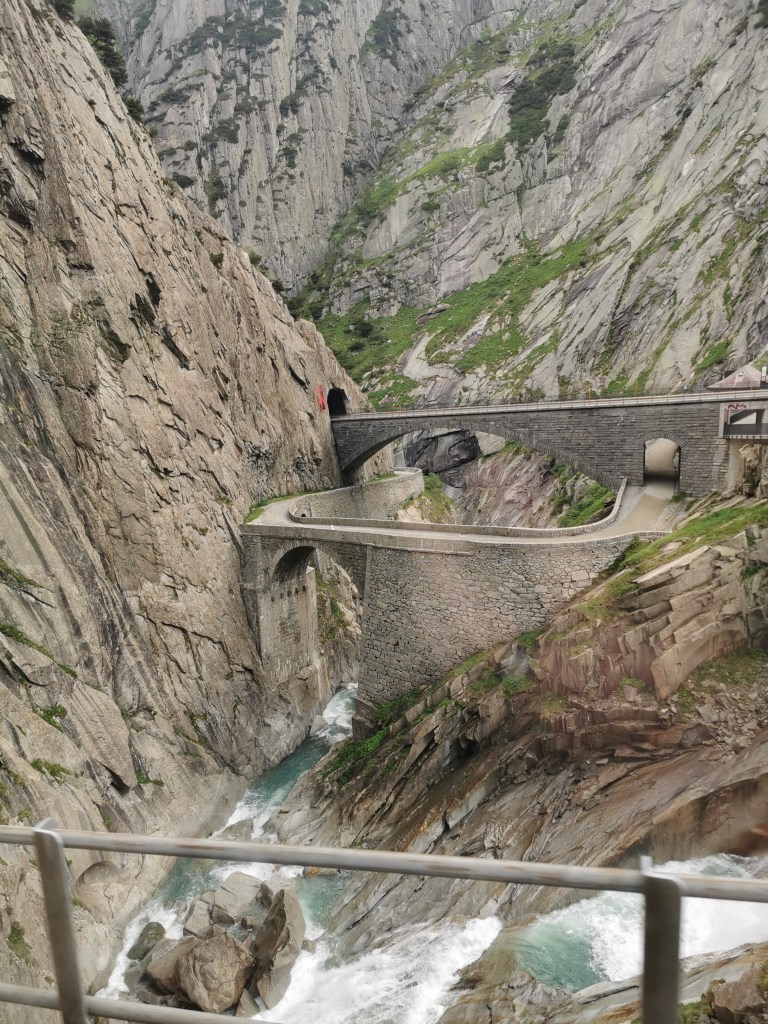
Our day out from Andermatt took us through both the Gotthard rail tunnels. Reading this it feels as though we were collecting tunnels on this trip, but it is difficult to avoid them in the Swiss Alps. The day started by catching the little train that pootles downhill on a rack from Andermatt, past the Devil’s Bridge (pictured), to Göschenen. Göschenen is on the former main Gotthard line from Zurich to Milan. Though it is bypassed by the new Base Tunnel, an hourly train service has been retained on the old scenic route serving local towns and village.
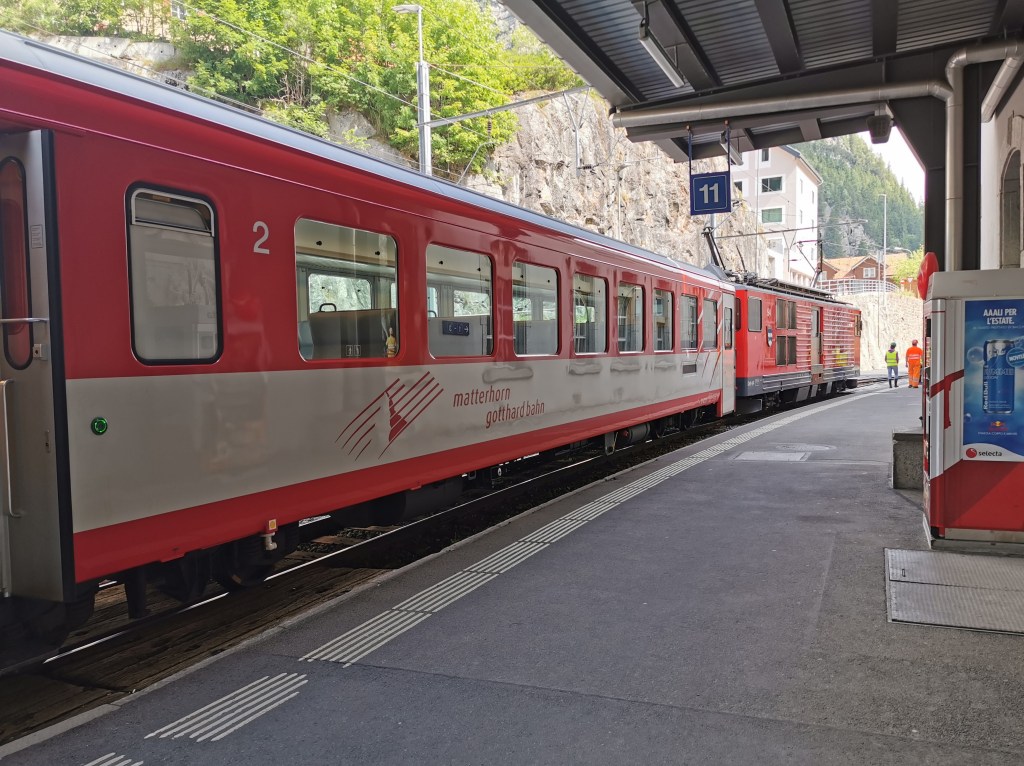
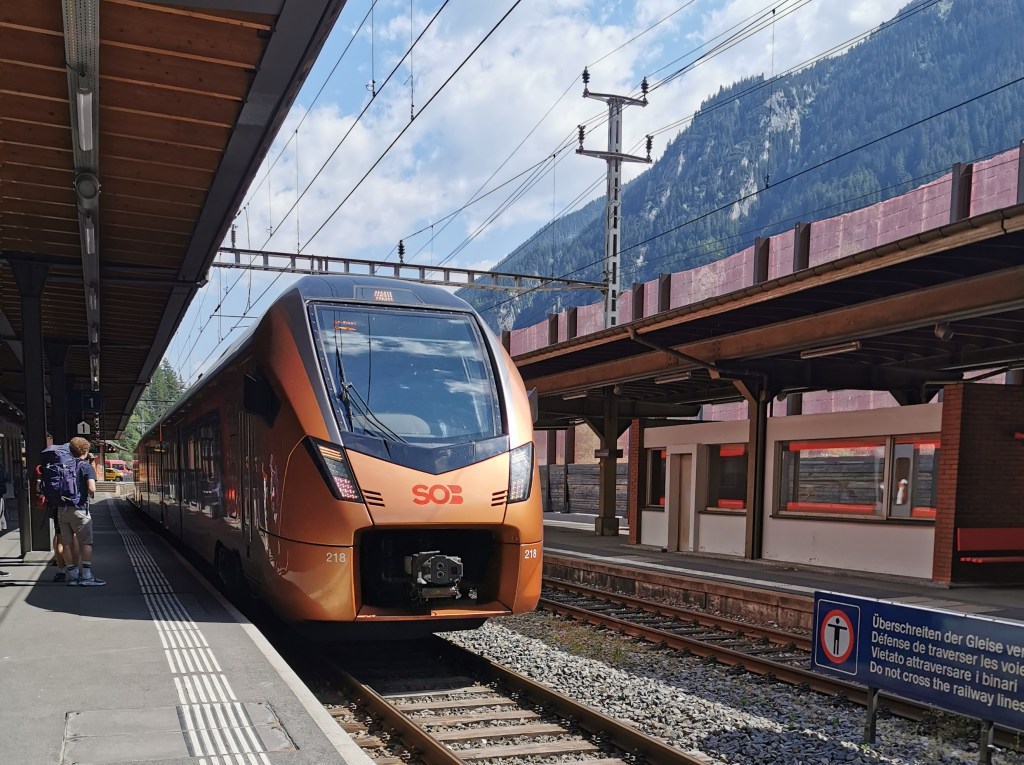
changing trains at Goschenen
The north portal of the original tunnel is by Göschenen station, the south is at Airolo in the Canton of Ticino and Italian speaking Switzerland. The journey down the Valle Leventina from Airolo includes spiral tunnels to assist in losing height.
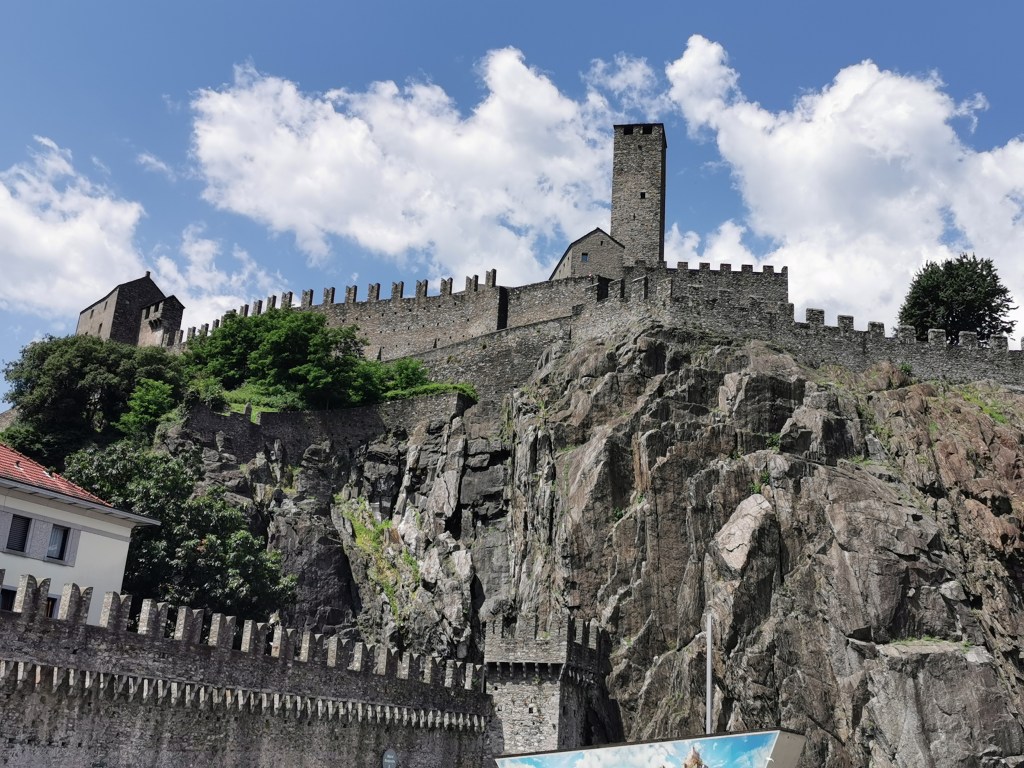
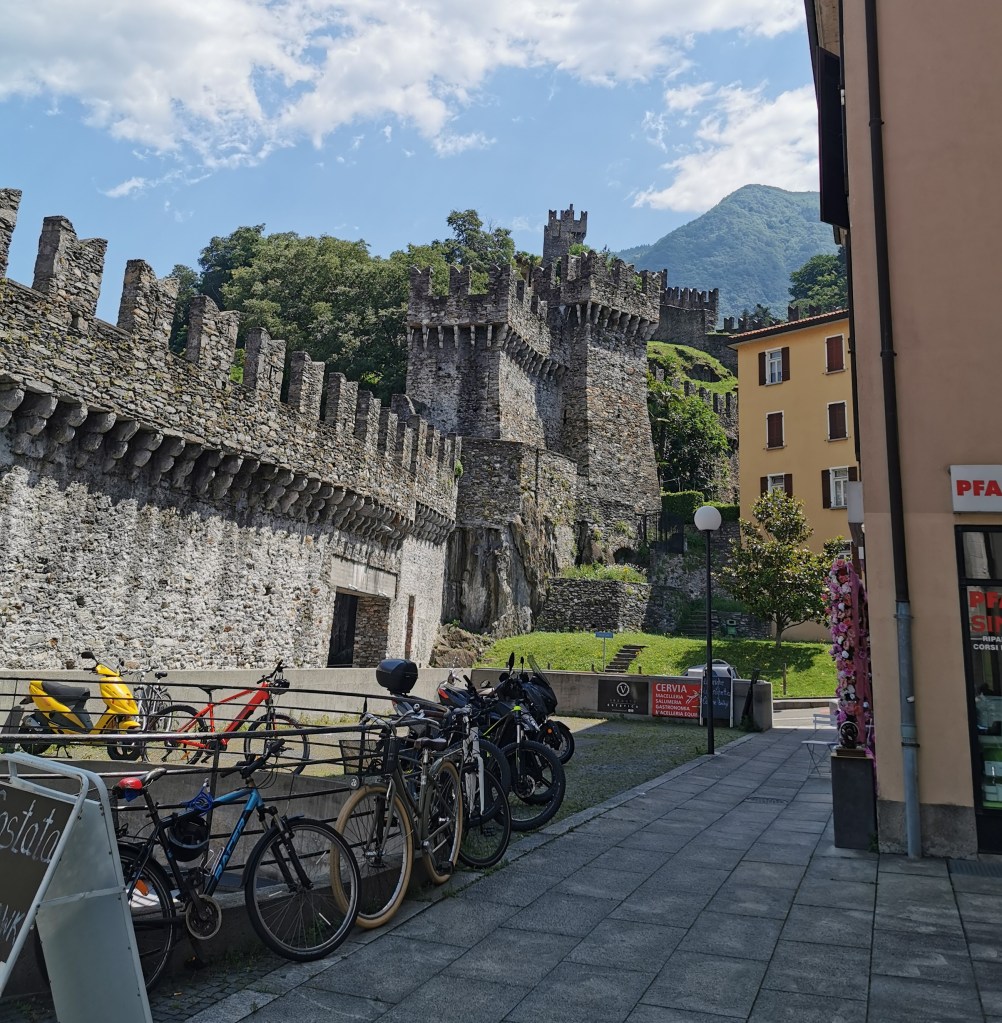
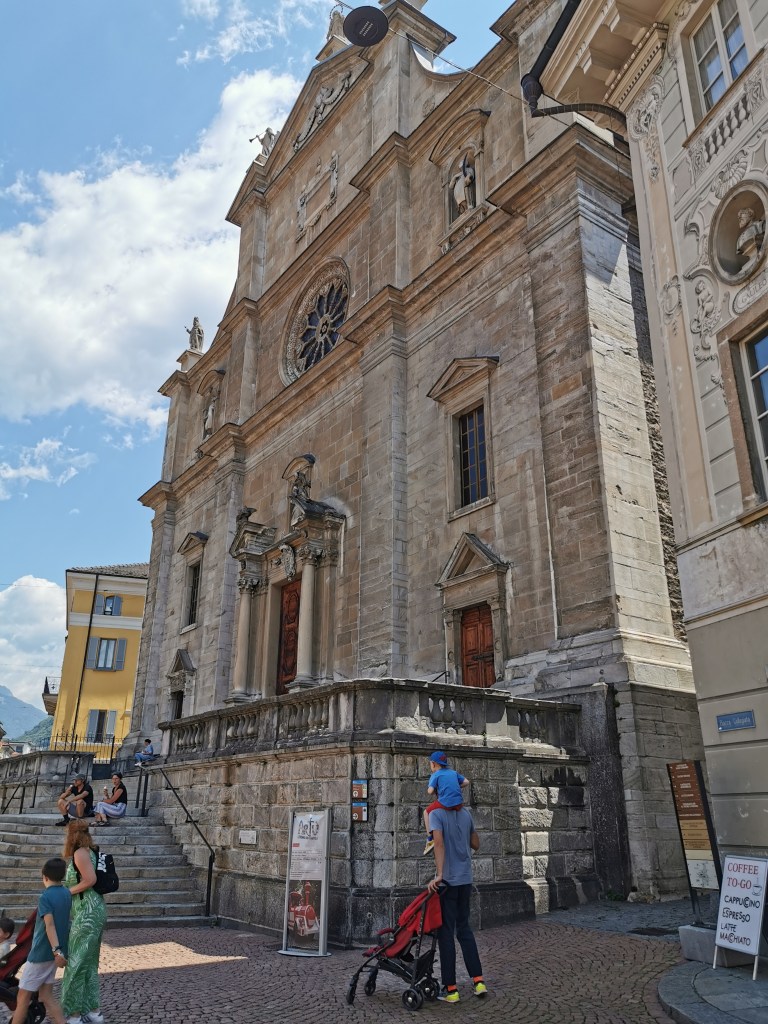
Our destination was Bellinzona, where we had some time to explore. It is a pleasant town which boasts several castles. On a sunny day the pavement cafes were busy and lively. We finished our brief visit with a beer in Birreria Baverese, accompanied by some free pizza. We people-watched – the station platform across the road had a mirrored roof, providing the impression of people walking upside town suspended from the ceiling.


Time for our journey through the new Gotthard Base Tunnel – I admit to being nerdish enough to want to do it. It opened in 2016 and, at 57km, it is the longest rail tunnel in the world (note 7). It avoids the steep climbs to and from the old tunnel, which benefits both passenger and freight trains. Needless to say there’s not a lot to see. The route by-passes the town of Biasca as it enters the tunnel and emerges by Erstfeld, some 25km north of Göschenen. We were heading for Altdorf, but the first stop for the express trains through the tunnel is Arth-Goldau, from where we doubled back to Altdorf on a local train. Trains take 54 minutes from Bellinzona to Arth-Goldau via the new tunnel, or 2 hours 8 minutes via the old route, albeit with several stops.
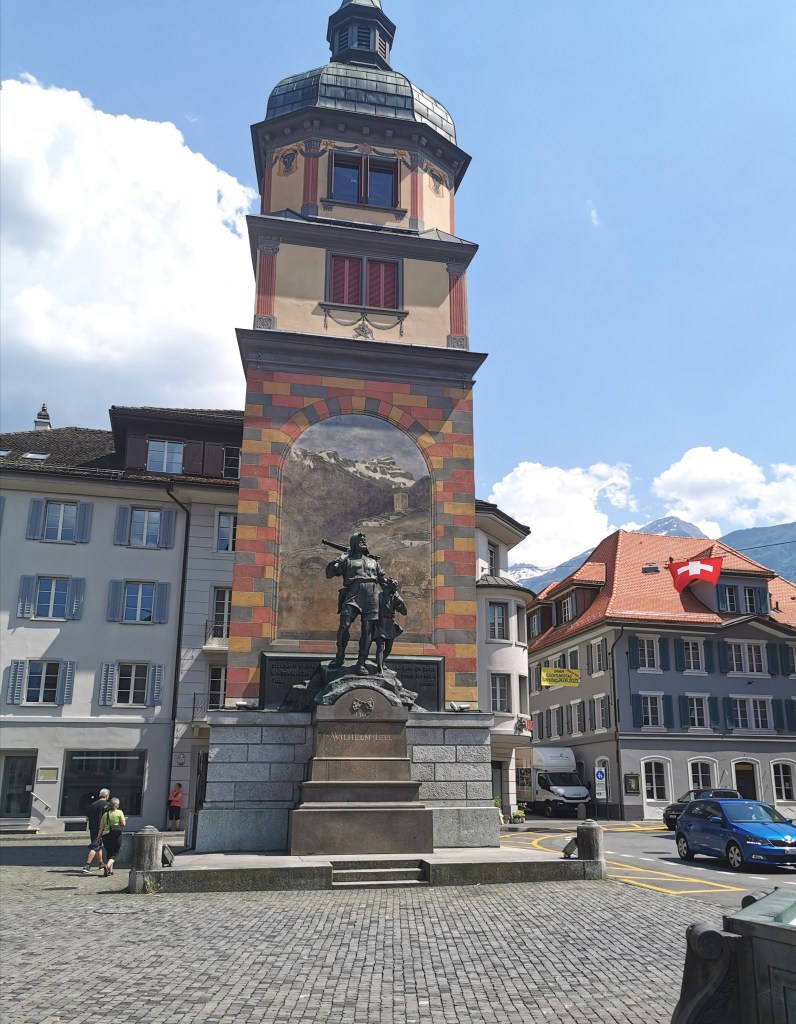
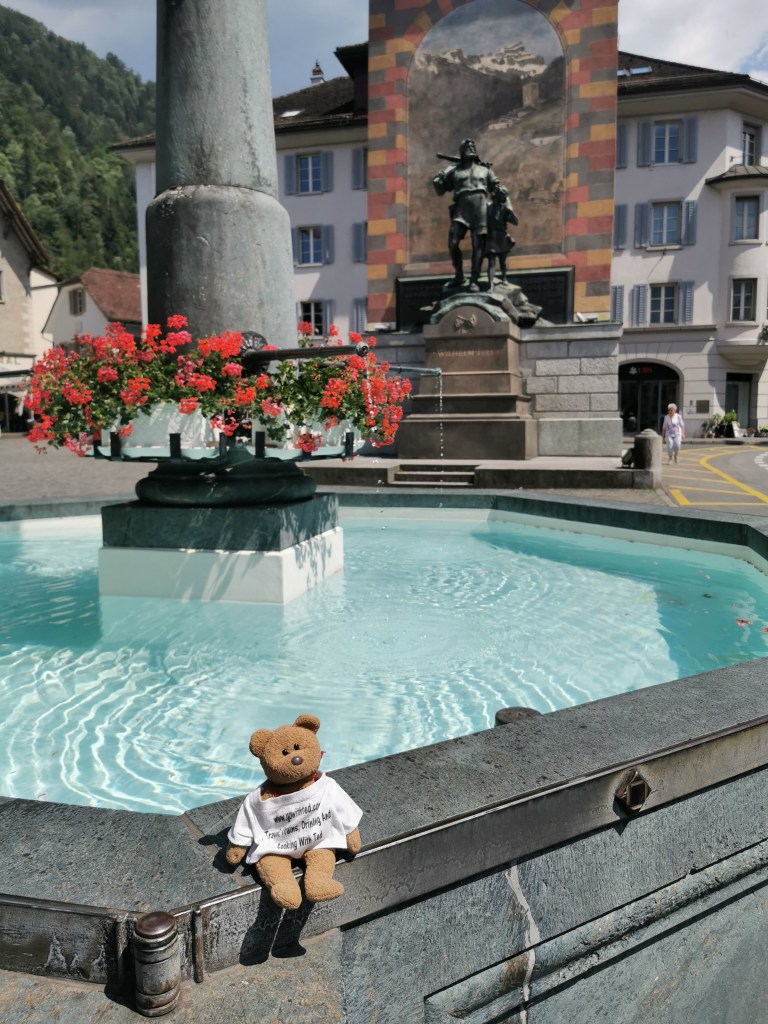

Altdorf station is some way from the town centre but, as this is Switzerland, there was a connecting bus waiting which dropped us off by the Telldenkmal – the William Tell monument, reputedly the scene of the apple-shooting event. Altdorf is a historic town and capital of the canton of Uri. We looked around, had a beer on the terrace of the Lehnhof, then sauntered back to the station for the train to Göschenen. The north approach to the old tunnel is quite spectacular as it climbs towards Göschenen, from where we pootled back uphill to Andermatt.

Andermatt – St Gallen – Zürich
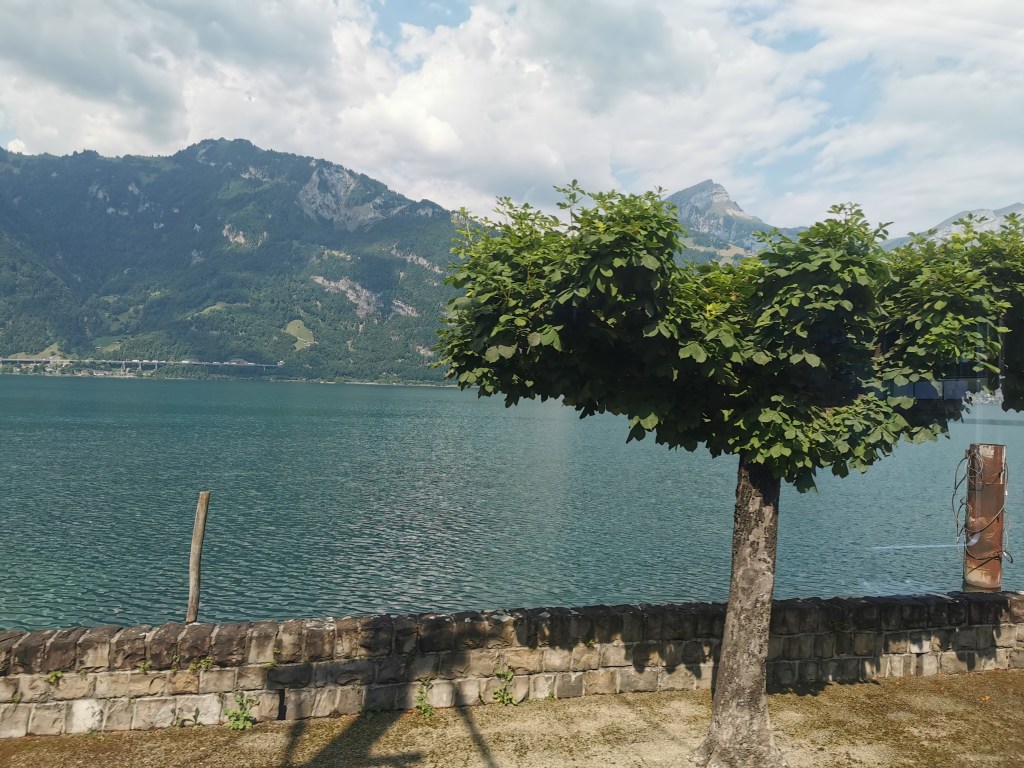
Our final destination was Zürich, travelling a long way round, with a lunchtime stop at St Gallen. We retraced yesterday’s steps to Göschenen and Arth-Goldau, passing through Flüelen and Brunnen and alongside the Urnersee (part of Vierwaldstättersee – Lake Lucerne)(note8).
There we caught the Voralpen Express, smart new trains operated by Sudostbahn, which took us through Biberbrugg, downhill to Pfaffikon, across the spit of land that separates the two parts of the Zürichsee to Rapperswil, then via Uznach, the Ricken-Tunnel (another tunnel!) and Wattwil to St. Gallen.
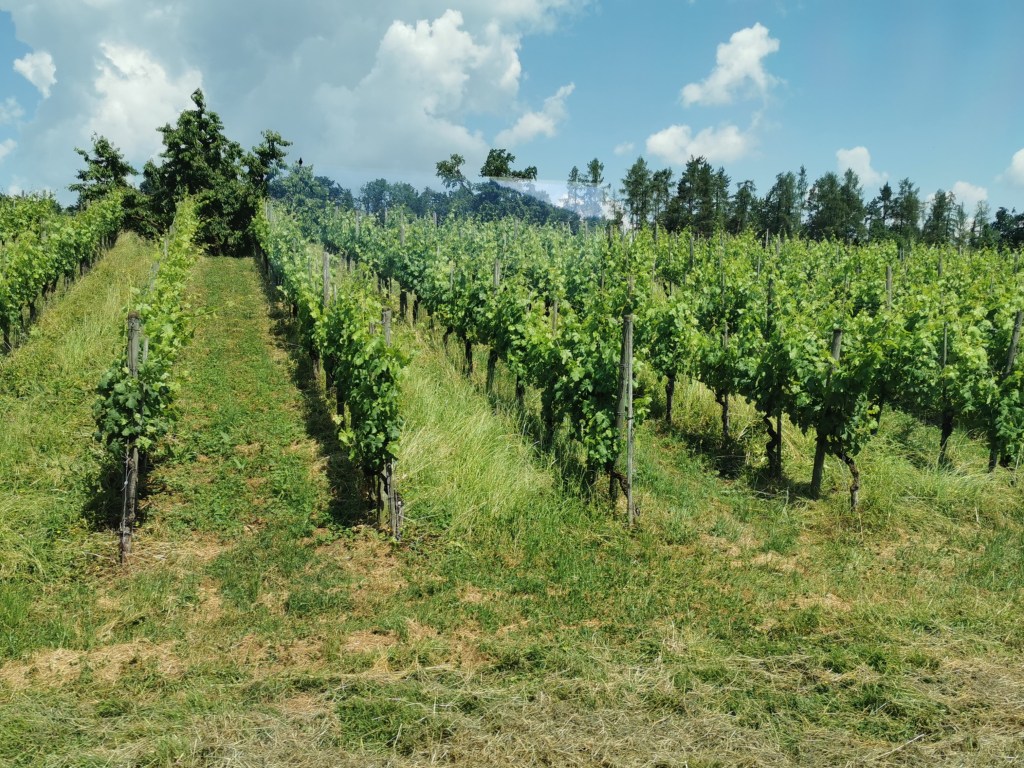

Vines growing near Pfaffikon and the castle at Rapperswil, from the train
It transpires that St. Gallen is named after Gallus, an Irish monk, and nothing to do with the Scots word. There were no available luggage lockers in the station so, with the rucky on my back, we only had a brief walk around.


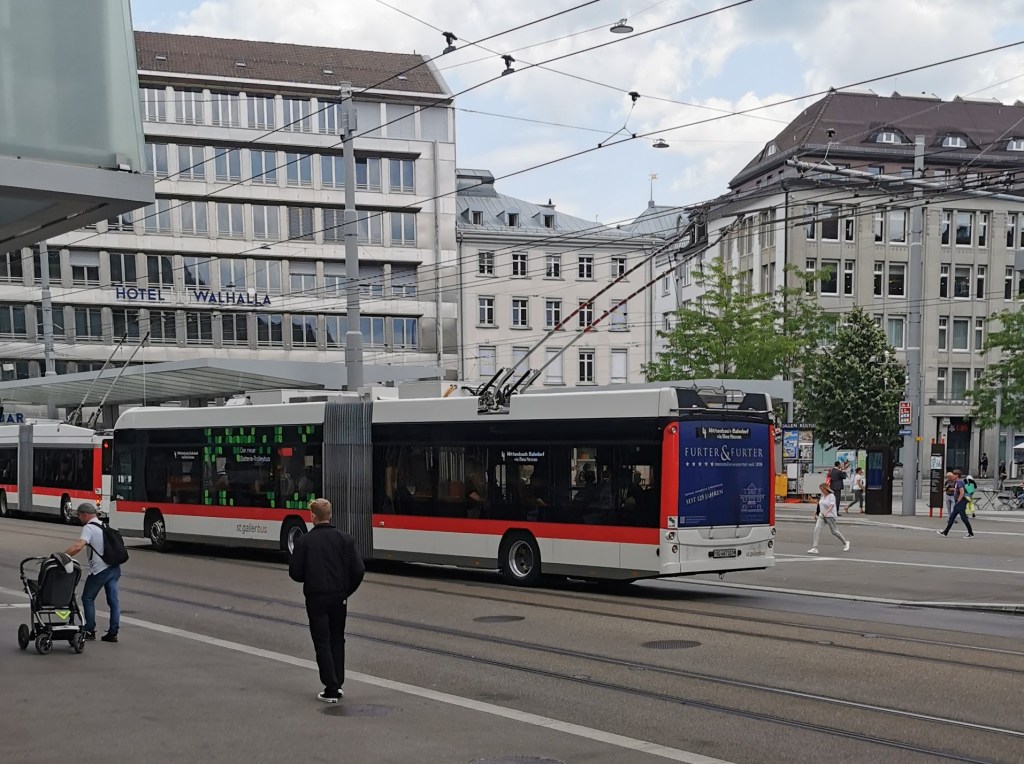
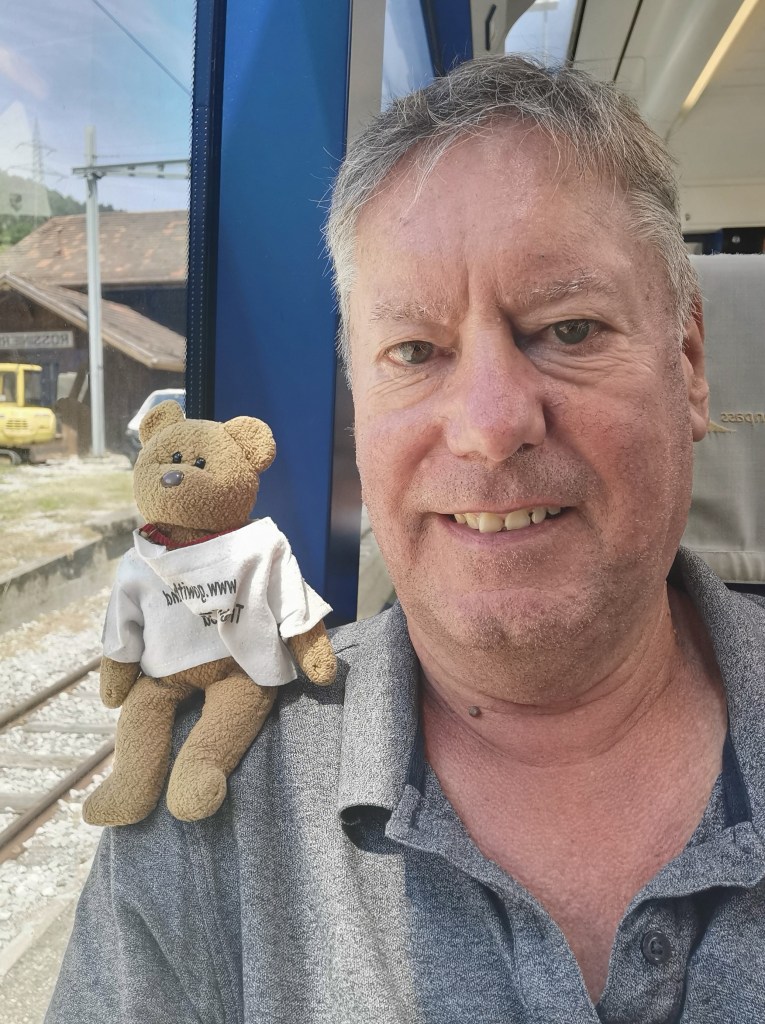
We met one of Ted’s relatives in his own square, Bärenplatz, then found the Brauwerk brewpub. The many patrons drinking coffee (on a Friday lunchtime!) were missing some excellent beer. For the transport nerds St Gallen was also trolleybus central with some very flash new trolleybuses on the routes radiating from the Bahnhof Platz and Appenzellerbahn tram-trains passing along the main streets.

Our Intercity train towards Zürich took us through more typical Swiss countryside until it became more built up from Winterthur onwards. On arrival at Zürich Oerlikon I used the station toilet, which had needle disposal bins in the cubicles – you can tell we were now in the big, bad city.
A tram took us the nearest stop to the hotel. However it wasn’t – the whole area was a building site, with blocked pathways and a lack of signposting. It was my choice to stay near to the airport rather than the city centre, but it was a hideous area of modern offices and warehouses, and the hotel was by far the worst of the trip
That evening we were tired and decided to go no further than the centre of Oerlikon. On first sight it didn’t seem appealing, but a look at Google Maps and Ratebeer revealed a couple of decent boozers and at least four Indian restaurants near to the station. So we had a couple of quiet beers in the Hoppy Corner, billed as a sports bar but pleasant, because the volume on the TVs was down, followed by one of the best Indian meals I’ve had in many years in the Malabar restaurant.
Zürich

The intention was to spend some time exploring Zürich, but the weather was becoming uncomfortably hot and I could tell that the air quality was not as good as in the Alps, so Plan B was to visit a nearby mountain and have a sail on the lake.
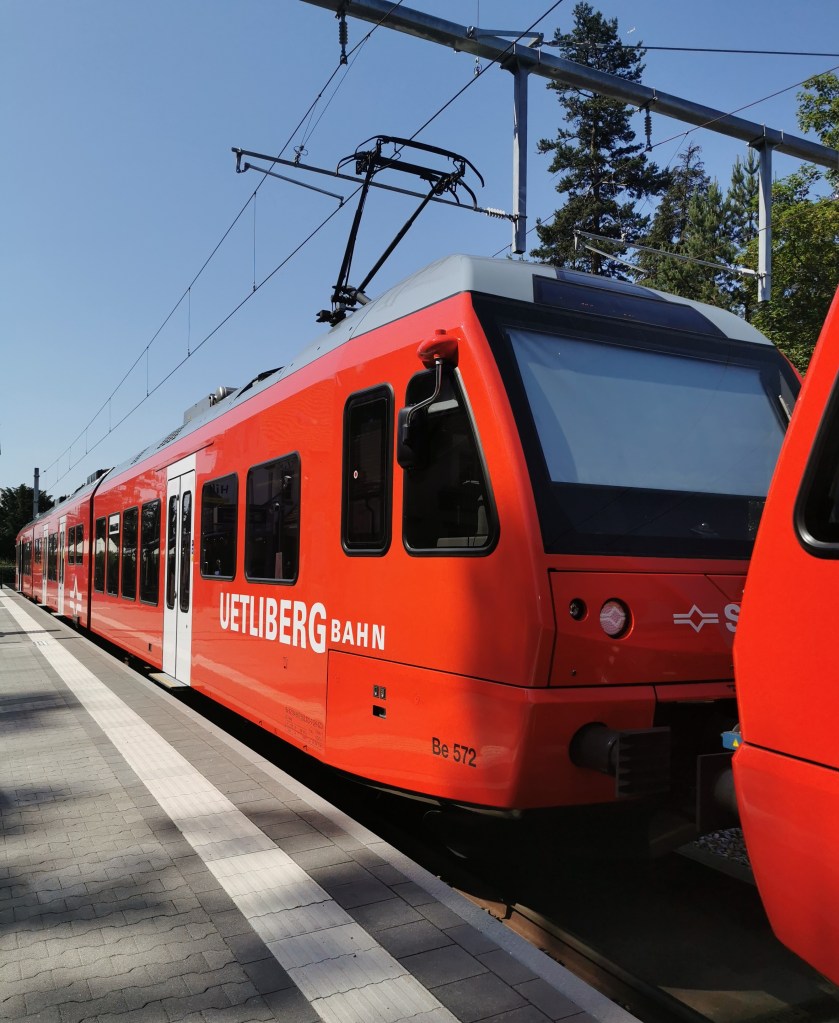

The Uetliberg is close to the city and reached by a frequent suburban railway line almost to the summit. We caught a tram into the city centre and managed to find the correct platform beneath the Hauptbahnhof. The summit station is reached after 20 minutes. There’s a café and restaurants and short but steep paths to the summit (870m) and the TV tower.


We took in the views over the city and the lake, had an early beer, then caught the train back down the hill to the Hauptbahnof, followed by a short tram ride through the city centre to the piers at the head of the Zürichsee.

We spent a very relaxing couple of hours on the outside deck of the boat, as we sailed along the length of the Zürichsee to Rapperswil, calling at 8 piers en route. Nearer the city the lakeside is suburban with a lot of very expensive real estate overlooking the lake. Further on are a series of small towns and countryside. The lakeside lidos and recreation areas such as Halbinsel Au and the island of Ufenau were busy with people enjoying a warm Saturday afternoon, and the lake itself was busy with sailing boats.

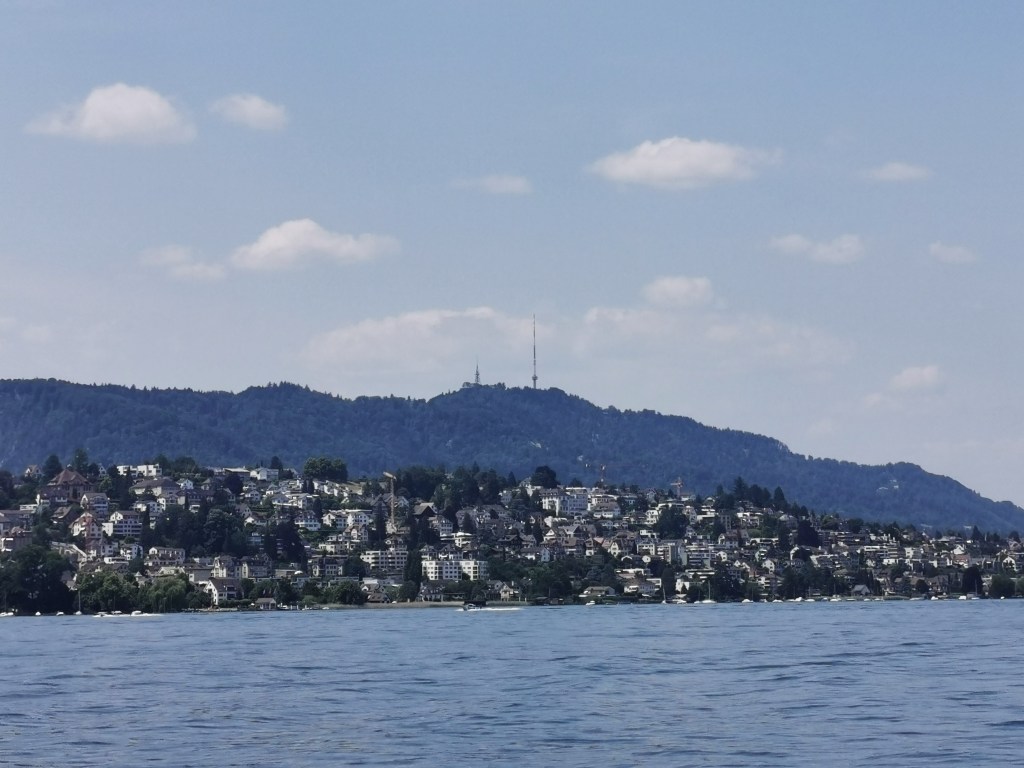
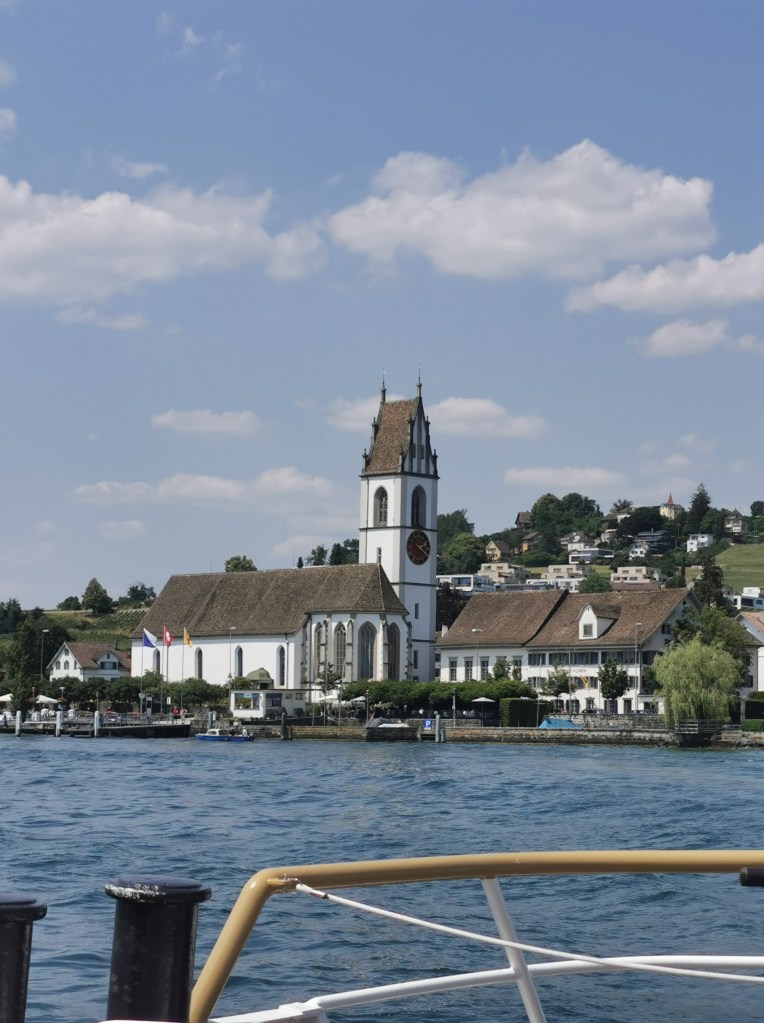


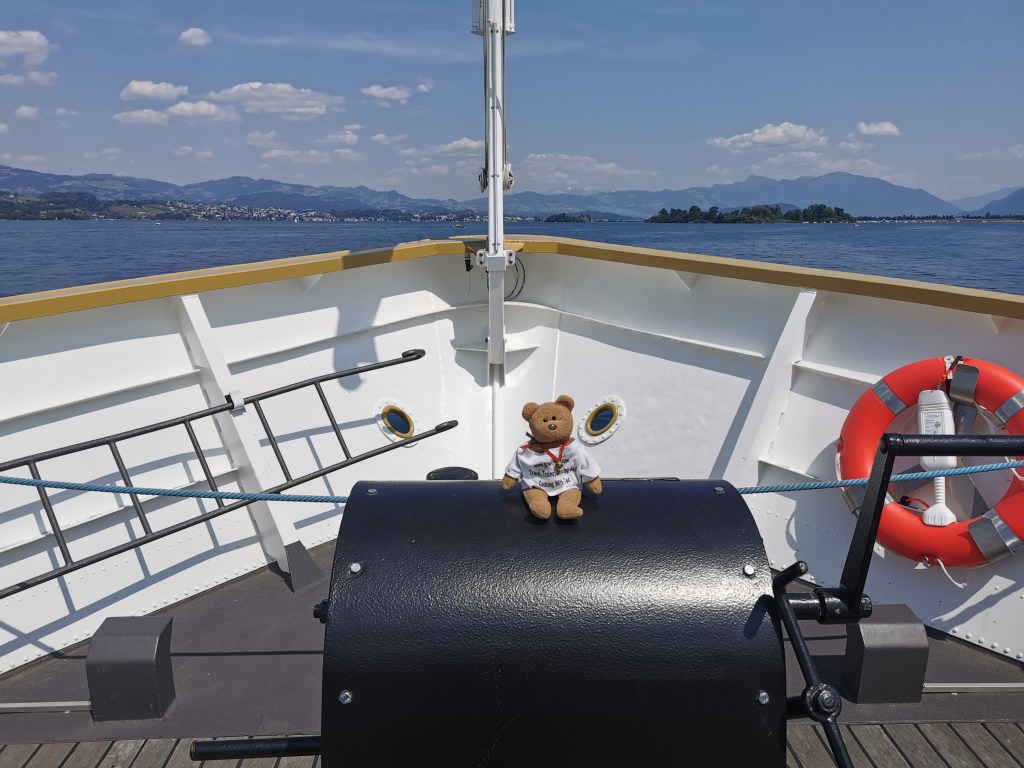
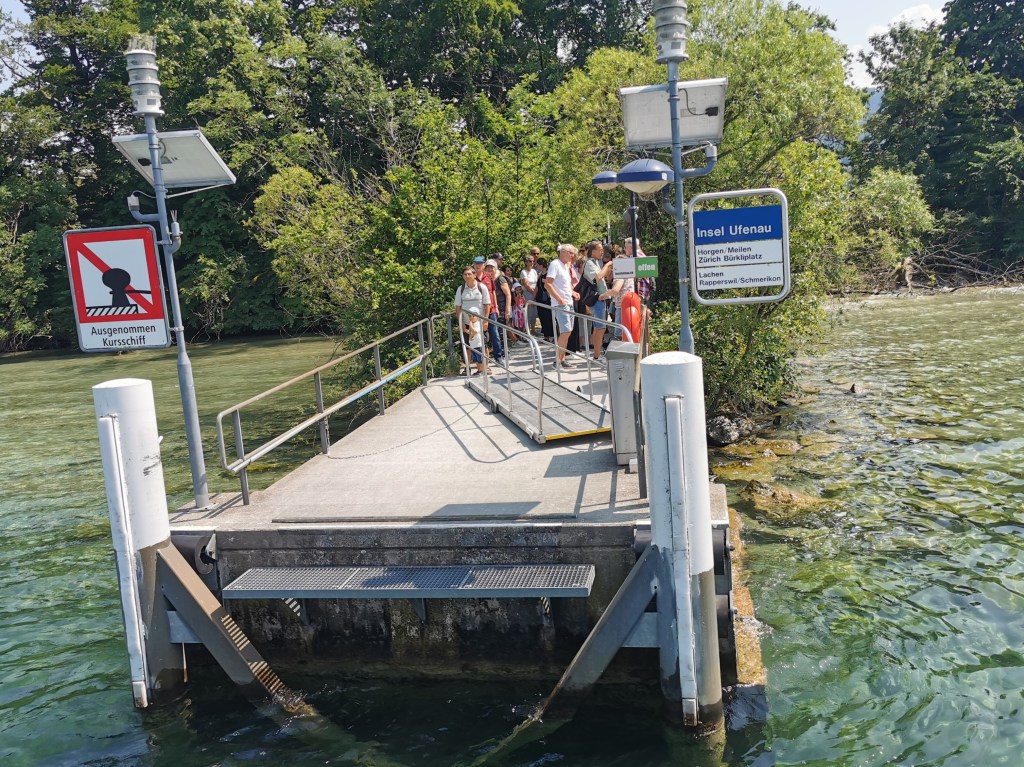

Rapperswil was busy – there was a music festival taking place and there were lots of food stalls around the stage in the main square – we continued our Indian food binge when we found a pakora stall. There’s an old town square with café and restaurant terraces (everywhere was full) and uphill there’s a castle overlooking the town. We found our way to the station, discovered the Nelson Pub opposite, sat on the terrace for a while, then caught a suburban train back to the city along the north side of the lake (note 9).

By then it was mid-evening and, as the train continued across the city to Oerlikon and we had an early start the following morning, we abandoned the plan to visit the bars of Zürich – so we will have to visit Zürich again in the future. After a brief stop in the Brasserie Oerlikon we caught a bus back to the hotel for an early final night in Switzerland.

Zürich to Málaga
In the morning we caught a tram to the airport. This time we had to pay because our pass had expired and we had to cope with the ticket machine. We navigated our way through the airport despite the poor signage, which assumed that everyone had to check-in (whereas we had printed our boarding pass), and referred to two terminals, (though everyone had to go through the same security area to reach the gates). We set off for Málaga. For once I had a window seat, the weather was clear and we saw Bern, Fribourg and Lake Geneva clearly before the clouds appeared. By the time we reached the Pyrenees the turbulence began. We left Zürich in 30 degree heat and arrived in the Costa del Sol in heavy rain and a thunderstorm. Oh well.

Notes
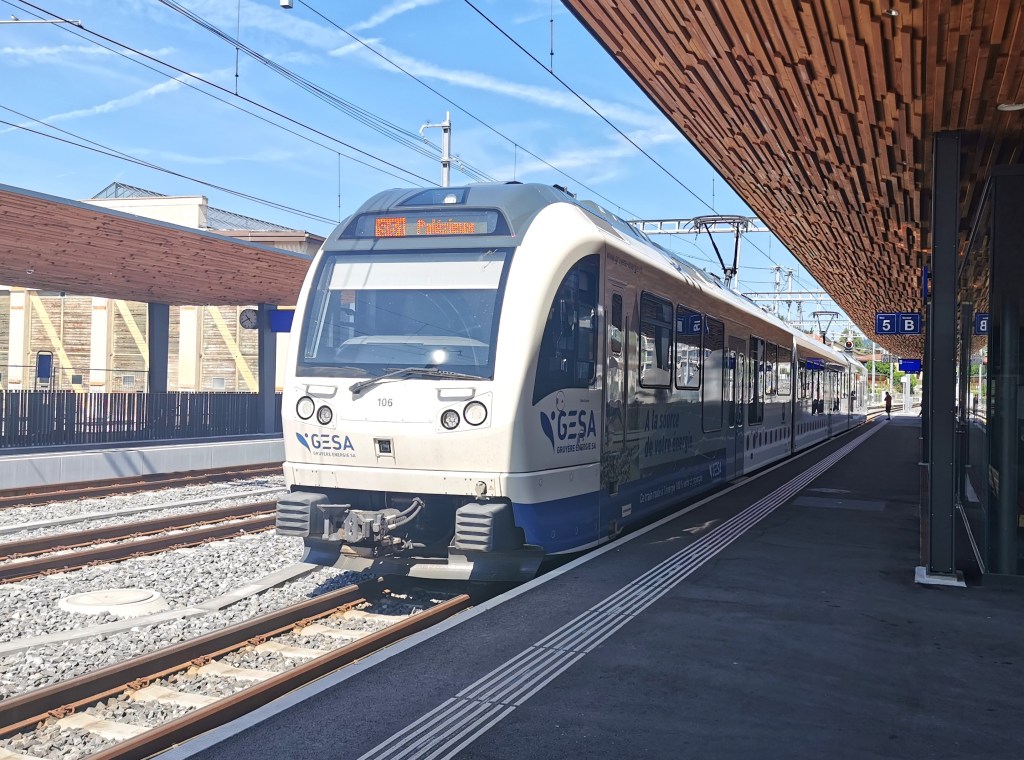
(1) Bulle was the end of the standard gauge line from Romont, where it met the narrow gauge line from Palezieux to Montbovon and its branch to Broc. The Broc line closed in 2021 and has been converted to standard gauge. It reopened in December 2022 as far as Broc-Village. The final section to Broc-Fabrique reopened on 26 August 23, the day when I am writing this page. The station at Bulle has been totally rebuilt and is being formally opened today also. This has allowed Transports Publics Fribourgeois to operate through trains from Bern to Broc via Fribourg, Romont and Bulle, as part of the Bern RER network.

(2) For more about Gruyères, which we visited in 2012, see the Lake Geneva section of Switzerland by Rail
(3) Source: Summer 2023 Info Guide Mürren/Gimmelwald.

(4) The Eiger Express cable car opened in December 2020. The route is 6483m long and takes 15 minutes, reducing the time for those in a hurry (why would you be?) to reach Jungfraujoch by 47 minutes. There are 44 gondolas, each carrying 26 people and it cost CHF470million to build. As part of the project Grindelwald Terminal station opened in December 2019.
(5) See ‘Grimsel Base Tunnel gains support’, Keith Fender, in Modern Railways, July 2023. The proposal is for a 21.2km long, metre gauge line, almost all in tunnel. This will link the station at Innertkirchen with Oberwald, beneath the Grimsel Pass.

(6) The band is called Sugarshakers and the tracks are Midnight Cruiser and Creepin’ up on you. Worth a listen. Hope they do well.
(7)The Gotthard Base Tunnel took 17 years to build and cost CHF 12.2billion. Shortly after our visit, on 10 August 2023, a freight train derailed in the tunnel. A single track re-opened for freight in late August but passenger trains will be diverted along the classic route until early 2024. ‘Freight train derailment closes Gotthard Base Tunnel’, Todays Railways Europe, Sept 2023, p6.
(8) For our 2019 visit to this area see Around Lake Lucerne .
(9) For more about Rapperswil as a rail centre see ‘Rapperswil A Swiss country junction’, by Jason Sargerson in Today’s Railways Europe, September 2023, pp36-39.
Practicalities
Getting Around

Swiss Travel Pass


I used an eight day Swiss Travel Pass which cost CHF389. For reference, at the time of writing CHF1 equals €1.05 and GBP0.9. The pass covers almost all public transport in Switzerland – trains, buses, trams and lake boats, plus free entry to many museums. There are reductions (usually 50%) on those mountain railways and cable cars which are focussed solely on tourists. There are various types of pass – for 3 – 15 consecutive days or a flexible option of 3-15 days within one month. Passes can be for first or second class. There are also many regional passes. For details of the options and prices see www.switzerlandtravelcentre.com .
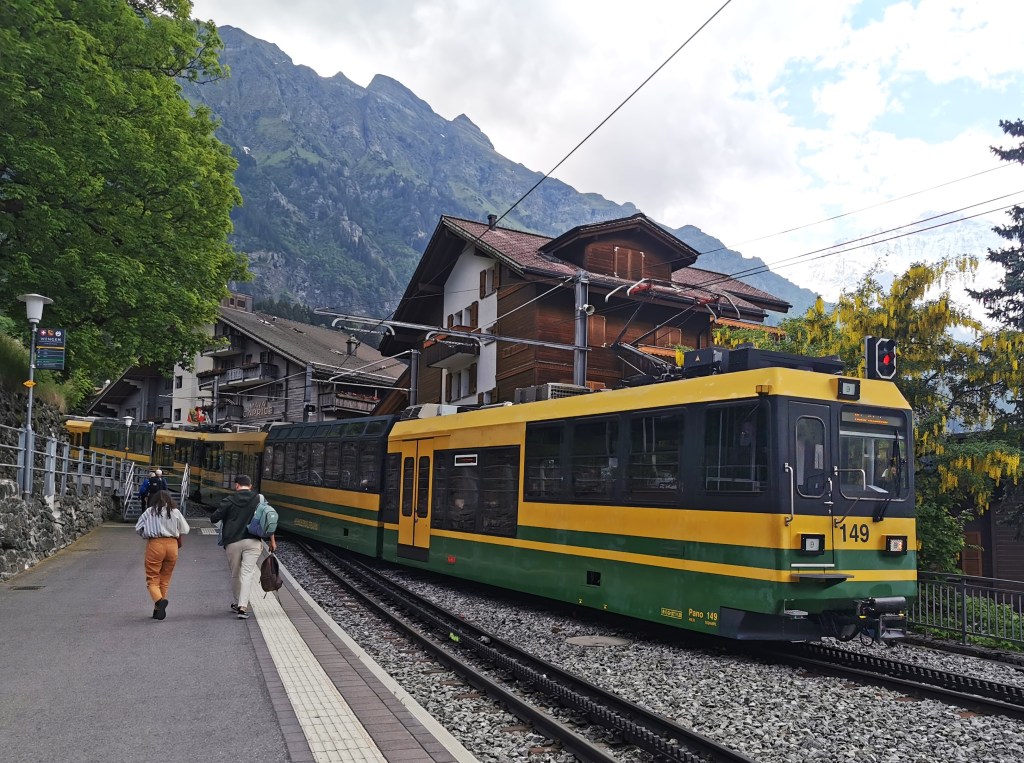

Be aware that. in the Interlaken – Jungfrau region, the reduction on the mountain railways and cable cars beyond the villages of Mürren, Wengen and Grindelwald is only 25%. My pass covered all of my journeys except the train from Wengen via Kleine Scheidegg to Eigergletcher and the Eiger Express cable car to Grindelwald Terminal which (with the 25% reduction) cost me CHF51.80. Anyone planning to reach Jungfraujoch should research their options carefully as the full return fare from Interlaken is from CHF211.20.
Trains times and information

Switzerland has an excellent public transport with regular trains connecting with each other and with buses. It has an enviable reputation for punctuality…though there can be the occasional hiccup. The best source of information is the SBB Mobile App. For those who prefer full timetables, the online Fahrplanfelder has been replaced by timetables at www.öv-info.ch , which takes a little effort to get used to. As elsewhere, printed timetable leaflets have virtually disappeared.

Hotels

The hotels we used were;
Geneva Airport – Ibis Genève Aéroport
Fribourg – Le Sauvage (pictured)
Mürren – Hotel Alpina
Andermatt – Alpenhotel Schlüssel
Zürich Airport – Ibis Zürich Messe Airport
The Sauvage was booked directly, the others via booking.com .
The middle three are all privately owned and were excellent and good value – I found Switzerland cheaper than my trip to Ireland in late 2022. The Geneva Ibis was OK and provides a free shuttle bus to and from the airport. I cannot recommend the Ibis Zurich Airport.
Prices
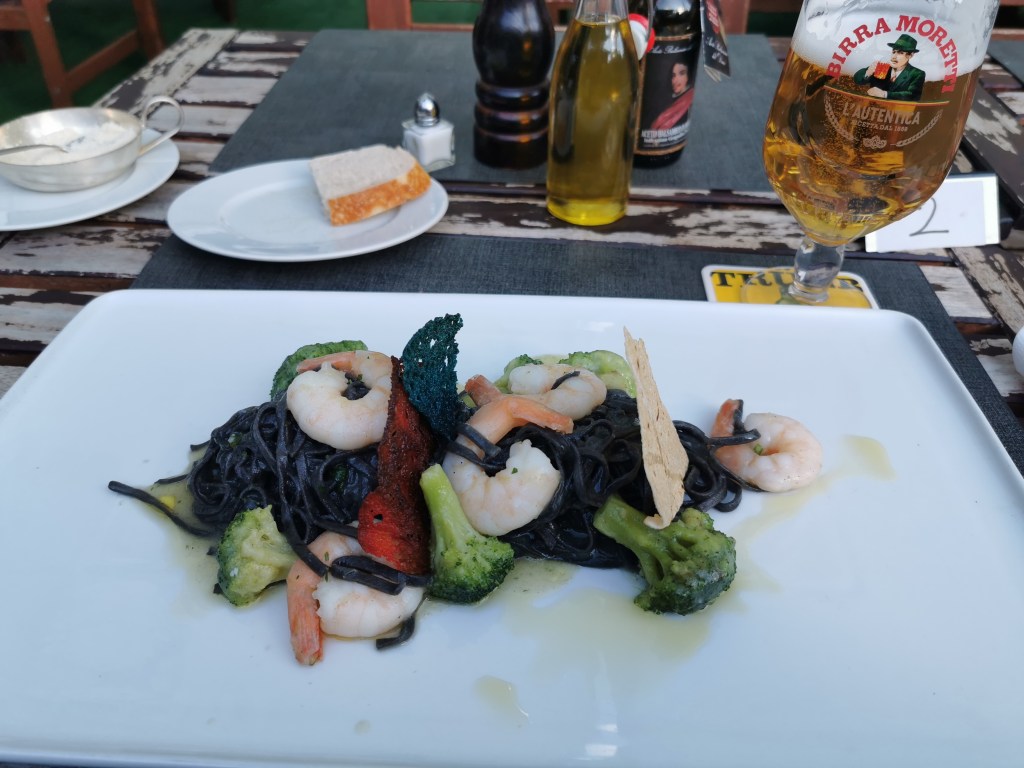
Switzerland has the reputation of being expensive, but using a pass brings down travel costs – standard fares are expensive. Beer-wise the standard 0.5l of beer was usually about CHF6 -7 – the cheapest I found was CHF5.50. Craft beers are more expensive. Wine is very expensive for the standard small 0.1l glass – though Swiss wines are pretty good. Food is expensive, both in supermarkets, and in restaurants, though the quality was excellent. Coffee prices are reasonable.
Photographs:
All photos are by Steve Gillon. The base map for our route is by SwissTravelSystem.com showing the validity of the Swiss Travel Pass
Copyright:
The text and photos are Copyright (c) Steve Gillon, 2023
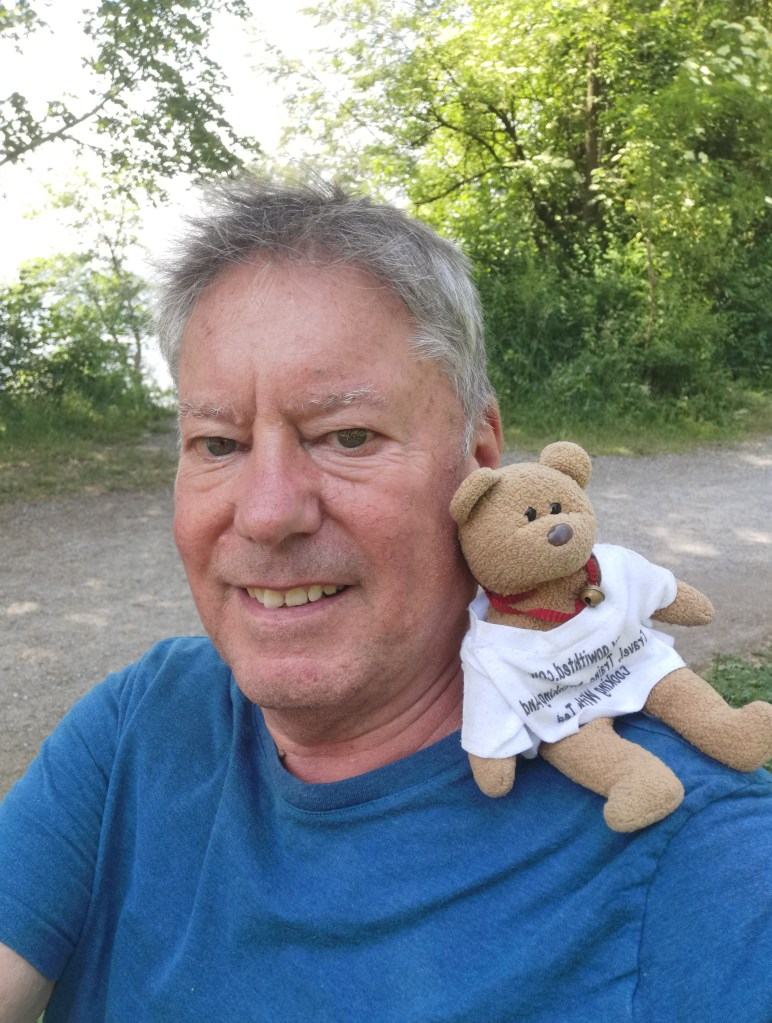
 Go with Ted